Breville BDC400BSS Guide: Six Modes of One Drip Machine
Breville BDC400BSS
A Drip Machine with Six Brew Presets, and the Dial That Justifies the Price
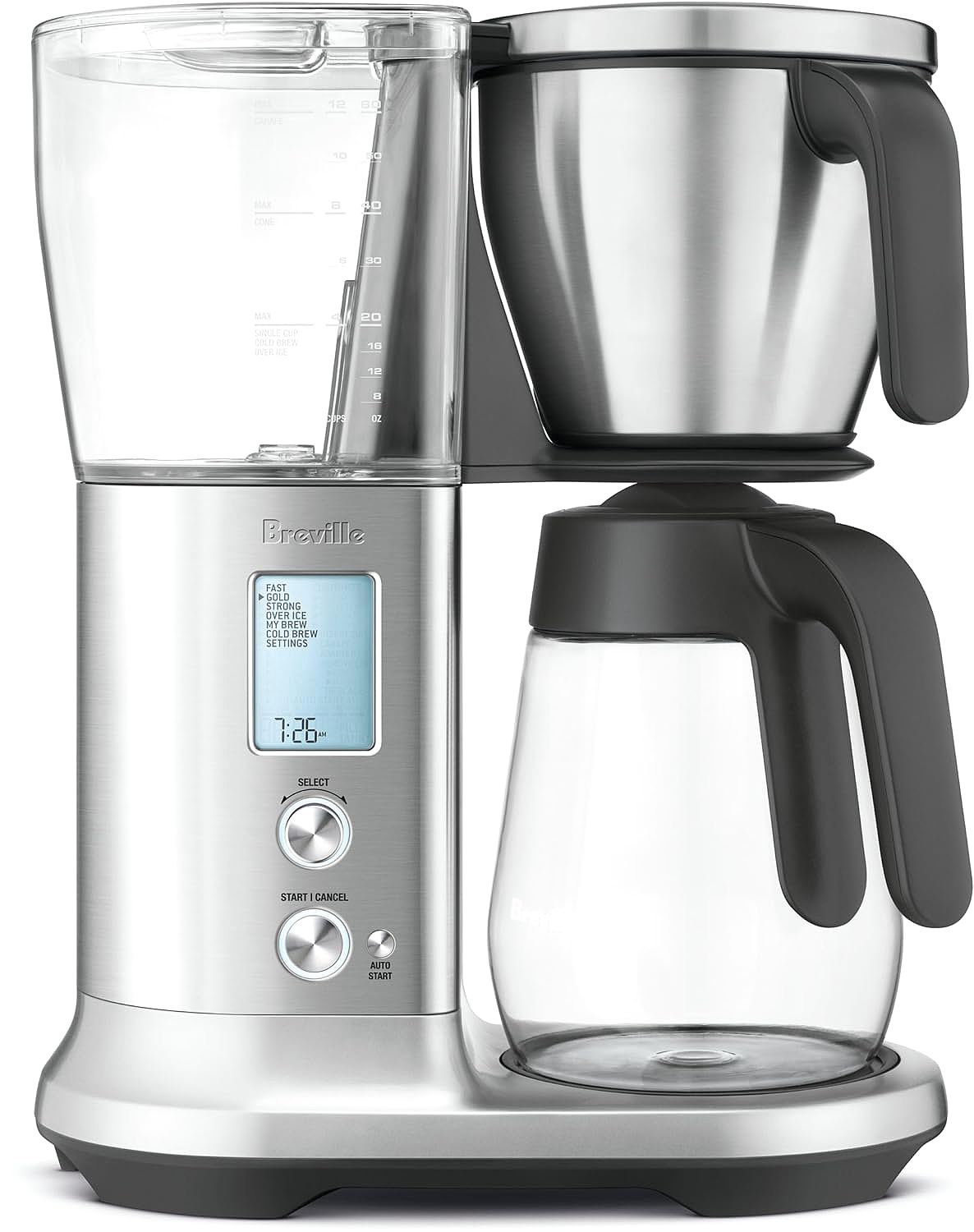
The Breville BDC400BSS precision brewer is a 60 fl oz glass carafe drip machine with a twist: instead of one button it hands you six brewing presets and a PID temperature control, so the variables that usually live inside the firmware end up on the front panel. At 299.95 dollars it is a serious outlay for a home dripper, and the six modes are six different answers to one question, which is how much water to push through a given dose.
What each preset changes
Three variables decide the cup, and none of them is new: the dose, the water volume, and the temperature. A preset is nothing more than a fixed answer to two of those, which is why one machine can offer six of them without six sets of hardware. What a preset saves you is the arithmetic, deciding how many grams against how many milliliters at six in the morning, and that arithmetic is the part most people get wrong. The temperature control is the piece that justifies the price, because the band between 93 and 95.5 deg C is most of the extraction window and a cheap machine cannot pin it.
Temperature you can repeat is the upgrade
Repeatable temperature is the upgrade that separates this from a timer machine, and the PID loop holds the brew right in the 93 to 95.5 deg C band rather than hope the element lands there. A pull hotter than the band drives more solubles into the cup and more bitterness with them; a pull colder than the band leaves the cup flat and sour, which is the failure that makes cheap drip taste like nothing. The dial makes the cup repeatable, because you set the temperature once and every pot comes out the same. For a roaster that asks for a 94 deg C brew, the machine makes the number followable instead of a guess, and that follow-ability is the piece a 60 dollar dripper simply does not offer.
Capacity and the ratio, worked out
Capacity is 60 fl oz, about 1.8 liters, which is a full 12 cup pot, and a medium grind with a 60 g dose against 0.9 to 1.0 liters of water lands the 1:15 to 1:17 ratio that keeps the cup balanced. A full pot of that strength runs 8 to 10 minutes. The ratio is the single number to keep: at 1:15 the brew is stronger and more forgiving, at 1:17 it is lighter and needs a cleaner bean, and the presets let you sit anywhere in between without doing the math each time. The carafe is the physical limit on how much you can make before the pot stops holding the temperature it needs. At a 1:15 ratio the full 1.8 liter pot wants about 120 g of coffee, which is two 60 g doses or a single large fill, and the presets handle that arithmetic so the strength stays the same whether the pot is half or full.
299.95 dollars against a timer machine
299.95 dollars is the list price, and the honest comparison is a plain timer dripper at 60 to 80 dollars. The premium buys the temperature control and the presets, and the per-cup cost is still set by the beans: a 250 g bag at 14 dollars is just over four 60 g pots, so the beans run about 3.4 dollars a pot, or 0.28 dollars per cup in a 12 cup carafe. A pot a day for a year is roughly 22 kg of beans, so about 1,220 dollars of coffee, and the 220 to 240 dollar gap over an 80 dollar timer machine is small next to that. The presets are the visible feature; the dial is the piece that justifies the gap, because it is the one control that changes the cup without you changing the beans. The math against the cafe is faster: at 0.28 dollars a cup against 5 or 6 dollars at a shop, two cups a day clears 220 dollars inside the first month. The carafe is glass rather than thermal, so it sheds heat once the brew stops; that is the trade against a sealed steel pot, and the second cup is where the trade shows.
The six named modes
The six presets are named, not just numbered: Gold, Fast, Strong, Iced, Cold Brew, and My Brew. Gold chases the SCA Gold Cup standard of 197 to 204 F, and the machine adjusts both the water temperature and the brew time to sit inside it rather than leaving the element to guess where it lands. Fast shortens the contact window against the same dose for a thinner cup, Strong does the opposite for a denser one, and Iced and Cold Brew hand the steep and the timing to a preset instead of you watching a jar in the fridge. My Brew is the open slot: you set the bloom time, the brew temperature, and one of the three flow rates yourself, and the PID control holds that choice steady pot to pot. On a home counter, the six named presets do different work from a single default: the default answer varies only how much water passes through the dose, while the six modes vary how the steep and the timing sit around it, so the machine is built for people who change one of those variables deliberately instead of leaving it fixed.
Steep & Release, and the second filter basket
Two hardware details carry the small-pot brews. The patented Steep & Release valve holds the water against the grounds for the full contact time, so a single cup does not run thin just because the carafe is off; it releases at the end and the cup keeps the extraction a full pot would have had. The dual filter baskets split the difference, a flat bottom for standard paper and a cone for the pour-over route, and Breville rates the pour-over adapter for drippers such as the Kalita Wave, which turns the machine into a controlled pour-over stand as well as a drip maker. The box covers the rest: the glass carafe, a coffee spoon, the cone insert, a mesh basket, a ten-pack of flat bottom paper, and a water hardness test strip, so a first brew wants nothing but beans and water. Underneath it is 1650 W on a 110 to 120 V supply with a two year warranty, the Breville standard rather than the discount one.

A starting grid for the six modes
The listing publishes the six mode names and the capacity, not a dose per mode, so treat this as a starting grid rather than a factory chart: pick the mode first, then set the dose to the pot you are brewing. Gold and Fast both run 60 g into 1.0 liter and differ only in contact time, so the same beans read fuller in one and thinner in the other. Strong raises the dose to 72 g against that liter, a 1:14 ratio. Iced goes the other way at 60 g into 0.6 liter, because the concentrate has to survive the ice. Cold Brew takes about 100 g into 1.0 liter and spends hours where the others spend minutes. My Brew takes whatever combination you give it.
Two settings are worth learning before the rest. My Brew takes a bloom time in seconds, and 30 to 45 seconds, counted from the first water, is the usual starting window, because a fresh roast spends the front of it pushing off carbon dioxide rather than giving up flavor. Steep & Release matters at the other end of the range: with the carafe off and a small cup selected, the valve keeps the water in contact with the grounds instead of letting it run straight through, so a 12 cup machine can brew one mug without the thin, under-extracted result a normal dripper gives at that volume. Set the temperature first, the dose second, and the mode last.

Breville BDC400BSS
Related Essays

Breville Precision Brewer Thermal Coffee Maker: Brewing Science in Every Cup

SHARDOR CM1429TE-UL Programmable Coffee Maker

Cafe Specialty 10-Cup Smart Coffee Maker: Brew on a Schedule

Dominion D7215CMDB 15-Cup Drip Maker
Elite Gourmet EHC-5055# : The Perfect 5-Cup Coffee Maker for Busy Mornings

Elite Gourmet EHC9420 Coffee Maker: Brewing Simplicity and Flavor

Mixpresso Mini Coffee Maker: Your Perfect Single-Serve Coffee Solution

Mixpresso 2-In-1 Single Cup Coffee Maker | Brew and Go Convenience
Hamilton Beach FlexBrew Trio: Your Ultimate Guide to Perfect Coffee at Home