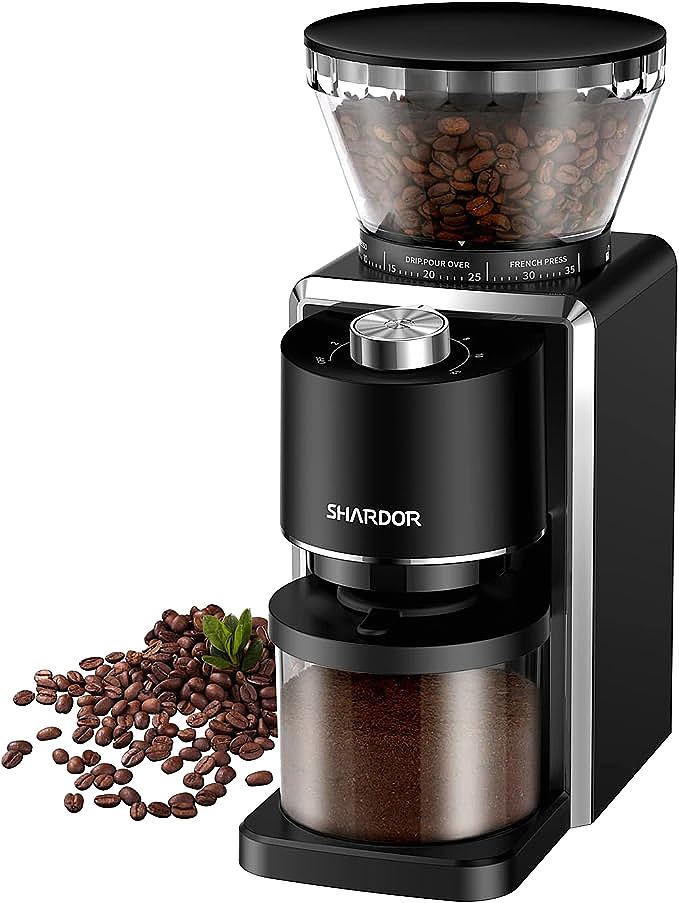
The Ultimate Guide to Your Conical Burr Coffee Grinder

SHARDOR Conical Burr Coffee Bean Grinder, Anti-Static, 48 Settings, Silver
The taste of a freshly brewed cup depends heavily on how evenly the beans were ground. When particle sizes vary, extraction runs out of balance and the cup turns sour or bitter instead of sweet. A conical burr grinder controls that particle size. This guide covers what matters when comparing one, and how to use it day to day.
Why Conical Burr Grinders Matter
Blade grinders smash beans into uneven fragments. The result is a mix of powder and chunks that extracts poorly. A conical burr grinder uses two cone-shaped surfaces, one nested inside the other, to crush beans into uniform particles. Grinding every bean to the same size keeps extraction even across the coffee bed.
The SHARDOR Conical Burr Coffee Bean Grinder, Anti-Static, 48 Settings, Silver uses stainless steel conical burrs that operate at low speed. Low speed matters because friction generates heat, and heat drives off the aromatic oils that give coffee its character. A cool grind preserves those oils.
The 48 settings on this grinder cover the full range from coarse French press to fine espresso. That range is wider than most competitors. The Cuisinart DBM-8P1 (B00018RRRK, $66.99) offers 18 settings. The Ollygrin Burr Coffee Grinder (B0BR7QDXPG, $79.99) offers 30. The Aromaster Conical Coffee Bean Grinder (B0H1RNQV2V, $89.99) matches the 48 but costs about $20 more.
Uniform particle size means water extracts flavor evenly. When grounds are consistent, the soluble compounds dissolve at a balanced rate. The result is a cup that tastes sweet and complex rather than sour or bitter. This is the core reason baristas recommend burr grinders over blade models.
The conical shape of the burrs creates a natural feeding action. Beans drop into the gap between the outer and inner burr, where they are crushed and then milled as they travel downward. This produces fewer fines than a flat burr design, which shaves particles off in a single plane. Fines are the small particles that clog filters and create bitterness in the cup.
What to Compare Between Grinders
When you compare conical burr grinders, five features separate the capable from the compromised.
Grind settings count determines how precisely you can dial in a brew method. More settings mean finer adjustments. The grinder offers 48, tied for the most in this group. The Lonkion Burr Coffee Grinder (B0DHXMW3C8, $29.99) offers 28. The KIDISLE Conical Burr Coffee Grinder (B0FD3CCDQS, $59.99) offers 35.
Burr size and material affect grind consistency and durability. The OXO Brew Conical Burr (B07CSKGLMM, $98.99) uses 40mm stainless steel burrs. The Ollygrin also uses 40mm stainless steel. Larger burrs generally produce more uniform grounds at lower speeds.
Bean hopper capacity determines how often you refill. The grinder holds 9.7 oz, enough for roughly 12 to 15 cups of coffee. The Hamilton Beach Electric Burr Coffee Grinder (B07YQLF481, $39.95) holds 16 oz, the largest in this group.
Anti-static technology keeps grounds from clinging to the chute and container. The grinder includes this feature, as does the Aromaster. Without it, fine grinds cling to plastic surfaces and make a mess.
Control type affects daily usability. The grinder uses an LCD touchscreen with a precision electronic timer. The OXO and Cuisinart use physical dials. Touchscreens offer precise timer control; dials offer tactile feedback.
A Closer Look at the SHARDOR Conical Burr Coffee Bean Grinder
The grinder measures 7 x 4.6 x 13.8 inches and weighs 5.38 pounds. It is tall enough to fit under most kitchen cabinets but narrow enough for tight counters.

The precision electronic timer adjusts in 1 second increments up to 40 seconds. This lets you grind a precise dose by time. For example, if 10 seconds yields 15 grams of coffee at a medium setting, you know 20 seconds yields 30 grams. This repeatability is what makes consistent brewing possible.
The 9.7 oz bean hopper uses a locking system that keeps beans secure during grinding. The grounds container sits below the chute and catches all output. The anti-static coating on the container interior prevents fine particles from sticking to the walls.
The touchscreen panel sits on the front face, angled slightly upward for visibility. You press once to wake the display, use plus and minus buttons to set the time, and press start to grind. The interface is straightforward enough that you will not need the manual after the first day.
The conical burrs are made of stainless steel, which resists corrosion and holds a sharp edge longer than ceramic alternatives over years of regular home use.
How the SHARDOR Compares to Other Conical Burr Grinders
At $69.99, the grinder sits in the middle of the price range. The Lonkion at $29.99 is the cheapest but offers fewer settings and only basic static control. The SHARDOR 2.0 (B0BTXZH33B, $39.99) is a flat burr grinder, not conical, which changes the grind character.
The OXO Brew at $98.99 offers 15 settings plus 43 micro-adjustments. That micro-adjustment system is useful for espresso dialing but adds complexity. The 48 dedicated settings on this grinder cover the same range more directly.

The Cuisinart DBM-8P1 at $66.99 is a flat burr grinder with 18 settings and a 4 to 18 cup range. It grinds larger batches but offers less precision for single cups. This grinder is better suited to single cup or small batch grinding.
The Aromaster at $89.99 matches the 48 settings and adds anti-static technology, but costs about $20 more. For most home users, the grinder delivers the same core functionality at a lower price.
The Hamilton Beach at $39.95 has a 16 oz hopper, the largest here, but fewer grind settings and no precision timer. It suits users who grind large batches and care less about precise dosing.
Getting the Most from Your Grinder
Start with the grind setting your brew method requires. For drip coffee, use a medium setting around 20 to 24 on the dial. For French press, use the coarsest settings. For espresso, use the finest. The 48 dial positions on the SHARDOR Conical Burr Coffee Bean Grinder give a medium drip setting around 20 to 24, a coarsest spot for French press, and a fine enough setting that even espresso is on the same dial.
Grind only what you need for the current brew. Coffee grounds lose volatile aromatics within 20 to 30 minutes of grinding. Pre-ground coffee sitting on a shelf is already stale by the time you buy it.
Use the timer to dose by weight once you calibrate. Grind for 10 seconds at your chosen setting, weigh the grounds, and note the grams per second. From then on, set the timer to hit your target dose without a scale.
Keep the hopper full but not overflowing. With the 9.7 oz hopper on the SHARDOR Conical Burr Coffee Bean Grinder, Anti-Static, 48 Settings, Silver, that is roughly a week of morning coffee for a couple of people. Beans feed more consistently when the hopper is at least one third full. For light roasts, grind in shorter bursts to avoid heat buildup. Pause 5 to 10 seconds between 20 second grinding sessions.
If your coffee tastes sour, grind one or two settings finer. If it tastes bitter, grind one or two settings coarser. Small adjustments have a large impact on extraction. Change one variable at a time so you can taste the difference.
Experiment with different beans. A light roast from Ethiopia will taste different from a dark roast from Sumatra, and each may prefer a different grind setting. Keep notes on what works so you can repeat it. A simple notebook or phone note with the bean name, grind setting, and tasting notes is enough.
A stopped motor, an error code, and the burr brush
Clean the burrs every two to four weeks with a brush. Coffee oils accumulate on the burr surfaces and turn rancid, which taints the flavor of fresh grounds. A small brush makes this quick.
Wipe the touchscreen with a dry cloth. Do not use abrasive cleaners on the display. The anti-static coating on the grounds container can degrade with harsh chemicals, so wash it with mild soap and water.
When a long back-to-back grinding session stops the motor and the display shows an error code, do not reset it. The motor has thermal protection that triggers after extended use; unplug it and let it sit for 10 minutes. After cooling, it should resume normal operation.
For stubborn oils, run a small amount of uncooked rice through the grinder. The rice absorbs oils and carries them out with the grounds. Discard the rice afterward. Do this no more than once a month, as rice particles can dull the burrs over time.
Store whole beans in an airtight container away from light, heat, and moisture. A cool, dark cabinet is ideal. Beans stay fresh for 2 to 4 weeks after roasting when stored properly. Ground coffee, by contrast, loses its aroma within 20 to 30 minutes.
Matching a Grinder to the Way You Brew
A solo brewer who values repeatable single-cup dosing gets the most out of a grinder with a wide settings range and a timer that measures the dose by the second. At $69.99 the SHARDOR Conical Burr Coffee Bean Grinder, Anti-Static, 48 Settings, Silver combines 48 dial positions with a touchscreen timer and an anti-static grounds container, so the same dose can be repeated without a scale and the fine particles stay off the walls.
A household that grinds larger batches needs hopper capacity more than settings count. The Hamilton Beach Electric Burr Coffee Grinder holds 16 oz of beans, the most in the group, at $39.95. The Lonkion Burr Coffee Grinder at $29.99, the lowest price in the group, takes the other trade: flat burr grinding with 28 settings and no timer.
Espresso work pushes the need toward fine control at the tight end of the range. The OXO Brew Conical Burr at $98.99 layers 43 micro-adjustments on top of 15 base settings, and the Aromaster Conical Coffee Bean Grinder at $89.99 matches the 48-position range with anti-static handling.
The $69.99 SHARDOR brings 48 dial positions, a 40 second timer, an anti-static grounds container, and a 9.7 oz hopper into one machine. That combination is what a home brewer checks for when dosing without a scale: a wide settings range, timed dosing, grounds that stay off the container, and a hopper that keeps the coffee fresh between refills.
SHARDOR Conical Burr Coffee Bean Grinder, Anti-Static, 48 Settings, Silver
Related Essays

Joy Pebble CM5400BA-UL: Your Gateway to Barista-Quality Espresso at Home

German Engineering in Your Kitchen: Why the Bosch 500 Series Chooses Ceramics Over Steel

Home Espresso Machine with Milk Frother Buying and Usage Guide

HOMOKUS NK-0648 Coffee Maker: Brew Science & Programmable Convenience
Capresso 565 Infinity Conical Burr Grinder: The Science of a Perfect Grind


KINGrinder K6 Grind Settings: 240 Options Guide

Alessi Moka Pot Guide: Design Meets Pressure Brewing

How a Conical Burr Grinder Turns Beans Into Even Grounds