Inside a Super Automatic Espresso Machine: Grind, Dose, Foam, and Cleaning

Cafe Bueno Super Automatic Espresso Machine
A super automatic espresso machine earns its counter space in the first month, not in the first demo. The models that settle into daily use share one trait: the full cycle, from the first grind to the last rinse, fits the way a household drinks. A longer feature list is a weak predictor of that fit.
This guide uses the Cafe Bueno Super Automatic Espresso Machine as its working example, because the appliance runs on a single sequence. Whole beans drop into the hopper, a built-in grinder turns them into grounds, the brew unit tamps and extracts, and the milk system textures whatever the drink calls for. Every step hides a decision about coffee, and every decision shows up in the cup.
What the built-in grinder decides before brewing starts
A roasted bean keeps its aromatics behind cell walls, and the grinder breaks those walls open. The clock on flavor starts at that moment. Oxygen and moisture go to work on the exposed surfaces, the bright notes fade within a few minutes, and that is why grinding on demand beats scooping from a bag that has sat open for a week.
Grind quality matters as much as freshness. When particles come out in a mix of sizes, water pulls flavor from the small ones first and leaves the large ones half worked, so the shot reads sour and bitter at the same time. An even grind gives the water a single job to do.
The grinder on a super automatic espresso machine sits inside the housing, so the grounds fall straight into the brew chamber and brew within seconds. Grind size also changes how water moves through the coffee. A fine setting slows the flow and builds concentration, while a coarse setting opens the path for a longer, lighter cup. The adjustment range on this machine runs from very fine to coarse, and moving a single notch at a time is the way to test a new bean.

Dose, water, and temperature: the controls behind the shot
Espresso is a ratio problem before it becomes a flavor problem. A common reference recipe pulls a double shot from 18-20 grams of grounds into 36-40 grams of liquid in roughly 25-30 seconds, and the numbers trade against each other. Push the yield longer and the cup turns thin; cut the shot short and the flavor lands sharp and narrow.
Pressure does the heavy lifting in the background. Home machines build around 9 bars, roughly nine times the atmospheric pressure at sea level, and that is the force that pushes water through the packed bed of grounds and pulls oils together into crema. Consistency matters more than a peak number: a steady push extracts evenly, while a wandering one shows up as a cup that tastes different from shot to shot.
The finished shot carries its body in the form of dissolved solids, usually in the 8-12 percent range, and the crema on top comes from oils and carbon dioxide that the pressure pulls together. That layer settles into the reddish-brown cap that drinkers read as the sign of a fresh pull, and it fades within a few minutes.
Water temperature decides what the water can pull out of the grounds. The working window sits between 195-205 degrees Fahrenheit, or 90-96 degrees Celsius, and shots below that band taste sour while shots above it turn bitter. On a super automatic espresso machine, the temperature control stays in reach along with the water volume, so the recipe can follow the bean.
Those adjustments share one screen, and a change to one usually asks for a small change to another. Dose, grind, temperature, and water volume all sit in the same menu, which turns dialing in a bag of beans into a repeatable loop instead of a guess. Start with the dose in the 18-20 gram range, set the grind against the 25-30 second window, then adjust the temperature in small steps to taste.

How the milk system builds texture from steam
Milk changes character when steam meets it. Heat unfolds the proteins, air gets caught inside that unfolding web, and the structure holds its shape long enough to land in a cup. Fat carries flavor and body; whole milk sits near 3.5% fat, and that share is part of why dairy foam tastes richer than the lighter versions.
The texture target for most milk drinks sits between 140-155 degrees Fahrenheit, or 60-68 degrees Celsius, before the proteins scald and the flavor turns flat. The frother works with all milk types, and the controls separate foam volume from warm milk volume. A cappuccino and a latte can start from the same button with different numbers behind them.
One menu, 19 drink options, and a 7 inch screen
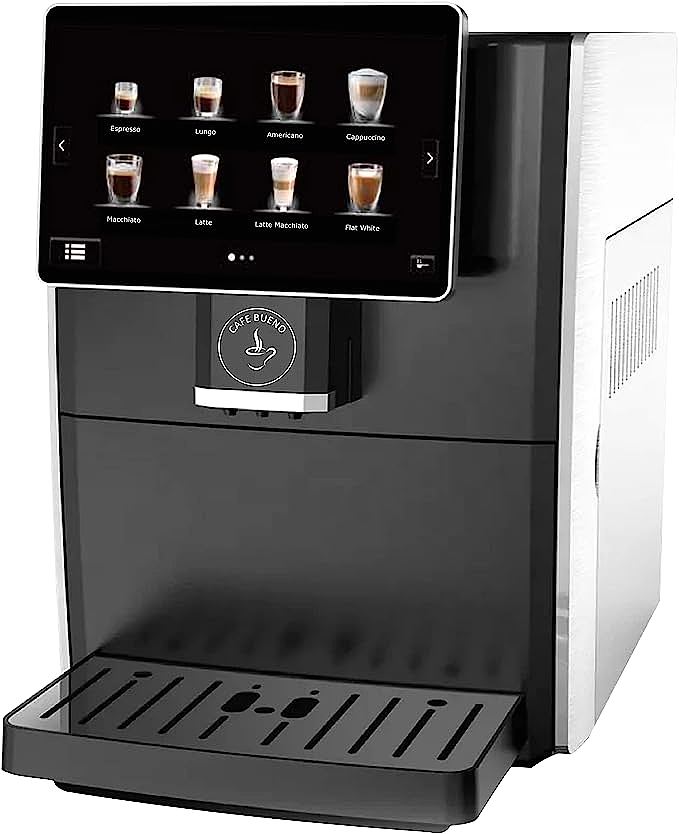
Count the drink list before anything else, because it decides how far a super automatic espresso machine reaches into a household's habits. This unit carries 19 customizable drink options: espresso and its longer relatives lungo and americano, the milk group that runs from cappuccino through macchiato, latte, latte macchiato, and flat white, plus warm milk, milk foam, and plain hot water for tea. Double versions cover the mornings that ask for more, and every recipe can be adjusted before it pours. A wide menu earns its keep on weekends and holidays, when the order changes and nobody wants to relearn a machine.
The screen is where the menu lives. A 7 inch touch display runs the interface, and the adjustable settings span the amount of coffee grounds, the grind, the temperature, the water volume, the milk foam, and the warm milk. Notifications appear when the water tank runs low, the grounds bin fills up, or the bean hopper needs a refill, so the small chores rarely stack into a surprise.

A weekday morning with the Cafe Bueno machine
Pick a Wednesday. At 6:40 the kitchen is still half dark, and the first order is a cappuccino. A mug goes under the spout, the 7 inch screen shows the drink tiles, and one press starts the cycle: the grinder spins, the brew unit tamps and extracts, and the milk line finishes the drink with foam on top. Nothing gets weighed, and no timer sits on the counter.
The second drink is usually a latte, and it takes the same path with a lighter touch: more warm milk, less foam, and the same single press on the screen to start.
By 7:05 the mug is empty and the last step is a rinse. The Cafe Bueno runs its milk system flush in seconds, the spent grounds land in an internal bin, and the counter wipes clean without a second appliance in the loop. That rhythm, more than any single feature, is the part a household lives with every day.
Four self-cleaning cycles keep the water path honest
Coffee leaves oils behind, and stale oils show up in the next cup as a dull, flat note. Water leaves minerals behind, and the scale they build slows the flow and shifts the brew temperature. Both problems start inside the machine, where a cloth cannot reach, which is why the cleaning design earns as much attention as the brew design.
The CB-3000 groups the work into four self-cleaning options, each one a button press away: a milk system clean, a regular brewer clean, a descaling program, and a deep brewer clean. A descale on a 2-3 month rhythm, sooner in a hard water area, keeps the heating path running clean. The milk side deserves the most attention, because dairy residue spoils faster than coffee oil.
What each cleaning cycle reaches
The milk system clean flushes the frothing circuit, where dairy residue would otherwise sit in the warm dark. The regular brewer clean rinses the brew group between deeper services, the deep brewer clean goes after the oil film that a quick rinse cannot lift, and descaling dissolves the mineral layer on the boiler side. Each cycle runs on its own timetable, which keeps flavor from carrying over between drinks.
Waste is the other side of the routine. A machine that runs on whole beans produces no pods, and the only everyday byproduct is the spent grounds in the bin, which can go straight to a compost pile. That habit costs nothing extra and keeps a steady stream of packaging out of the trash.
What the daily 10 cup ceiling means at home
At the time of this live check, October 2026, the listing for B0C42GG65T shows a price of $699.99 (live PAAPI), lists the Cafe Bueno machine as in stock, and describes it as a home unit rated for up to 10 cups of coffee a day. That figure frames the hardware: the tank, the grounds bin, and the brewing parts are sized for a kitchen rhythm of a few cups in the morning and a few more through the afternoon. A home office that pushes a dozen cups through every day is asking a home class machine to work a commercial shift.
The Cafe Bueno Super Automatic Espresso Machine fits that brief. Read the 10 cup figure as a design target rather than a hard stop: it points at the parts that get stressed first, and it keeps expectations straight for anyone moving up from a drip pot.
Before the order ships, run the math on a normal week instead of the best-case morning: how many drinks, which milks, how loud the grinder runs at dawn, and whether the cleaning loop is one you will keep running without dread. A super automatic espresso machine rewards the household that answers those questions first. The drink menu makes the first week easy, and the cleaning design decides the years that follow.
Cafe Bueno Super Automatic Espresso Machine
Related Essays

Neretva PE3650U 20 Bar Espresso

Your First Espresso Machine, Beginner Guide

How the LIS ADORN Dripper Manages Extraction Pressure

Espresso Extraction, Thermodynamics at 15 Bars

Joy Pebble CM5400BA-UL: Your Gateway to Barista-Quality Espresso at Home

KEENSTAR BCM2201 Espresso Machine: Honest Budget Espresso at Home
JASSY JS-100 Espresso Coffee Machine: A Guide to Home Brewing

How to Choose an Espresso Machine With a Built-In Grinder