SHARDOR CG836 Grind Settings: 25-Step Burr Grinder Guide
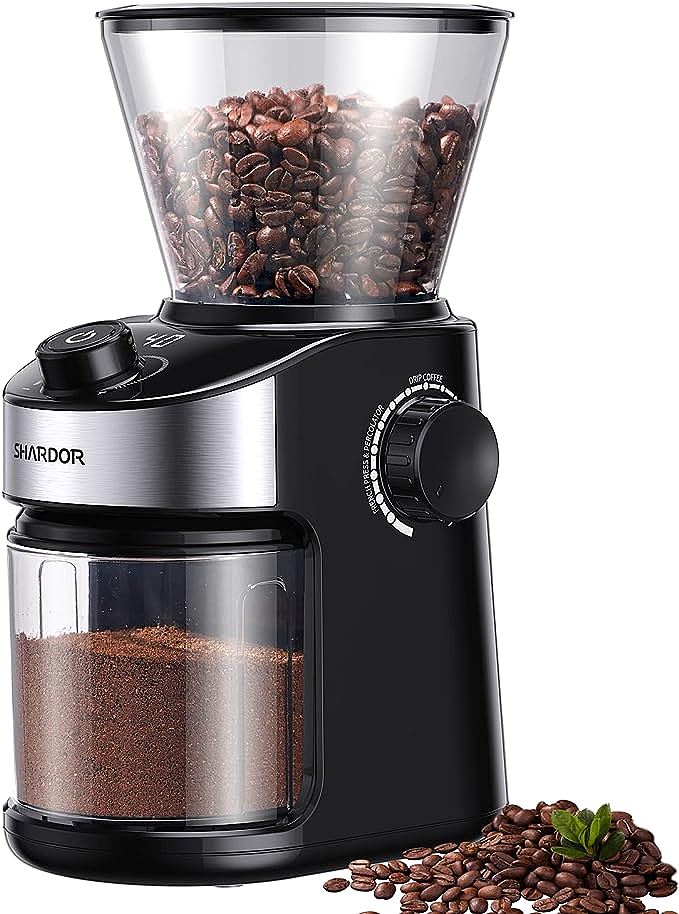
SHARDOR CG836 burr coffee grinder
The SHARDOR CG836 burr coffee grinder (ASIN B0BQR5CHHY) presents a 25-position dial, yet the accompanying documentation offers no guidance on which position suits which brewing apparatus. This SHARDOR CG836 grind settings guide addresses that gap. Without a reference point, you experiment blindly. One day the brew arrives under-extracted and acidic. You rotate the dial. The following day brings bitterness and astringency. Identical beans, identical water, identical brewer. The sole variable is particle dimensions.
A numbered dial does not indicate quality tiers. It maps a coordinate space. Each brewing device needs different settings within that space. Match the numeral to your brewer, then allow the resulting cup to guide further adjustments.
How Brew Method Dictates Your Initial Dial Setting

Extraction occurs when hot water dissolves soluble compounds from ground coffee particles. The rate of dissolution correlates directly with available surface area. Finer particles expose more surface area to water. Coarser particles expose less. Particle dimensions control how fast extraction happens, and every subsequent recipe parameter builds upon that foundation.
Brewing devices vary along two critical axes: contact duration and applied pressure. French press immersion maintains water and coffee in contact for approximately four minutes without external force. Espresso equipment compels water through a compressed coffee bed at nine bars of pressure within roughly thirty seconds. Drip and pour over occupy the intermediate range, relying on gravitational force.
A particle dimension that achieves full extraction during four minutes of immersion yields minimal flavor during thirty seconds of espresso flow. Conversely, a particle size appropriate for espresso would over-extract into harsh, ashy bitterness within a French press. No single grinder position serves two different brewers. The dial numeral is a compromise point between surface area exposure and contact duration.
Budget grinders in the forty-dollar category typically employ spinning blade mechanisms that fracture beans inconsistently, producing irregular particle distributions. Flat burr mechanisms operate on a different principle: two parallel hardened rings with cutting edges, one stationary and one rotating, compress beans within an adjustable gap. Moving from position 20 to 18 narrows that gap by a precise, reproducible increment. This reproducibility, rather than motor output, constitutes the value proposition of burr grinding.
The SHARDOR CG836 incorporates a metallic flat burr fabricated from hardened steel. Its 200W motor rotates the upper burr at consistent velocity, while the digital timer permits grinding duration adjustment in 1-second increments up to 40 seconds maximum. The bean hopper accommodates 200g of coffee beans, sufficient for up to 14 cups. The unit occupies 10.75 x 7.64 x 6.14 inches of counter space and weighs 2.97 lbs (1347g), fitting most kitchen surfaces without excessive spatial demands. A dual safety lock mechanism prevents activation unless both hopper and grind chamber achieve proper assembly. Thermal cutoff protection interrupts power when motor temperature exceeds safe limits. Automatic shutoff terminates grinding upon timer expiration.

French Press: Settings 20 to 24 and the Coarse Crystalline Target
French press brewing constitutes an immersion method. Coffee and water remain in contact within the carafe until a metal mesh plunger separates them at the conclusion. That mesh represents the design limitation: it cannot retain the finest particles, which migrate into the cup as sediment.
This mesh constraint explains why French press demands the coarsest dial settings. On a 25-step mechanism, begin between settings 20 and 24. The desired texture resembles coarse crystalline salt: discrete grains visible to the naked eye and tactile between fingertips. At this dimension, the majority of particles remain trapped behind the mesh during pressing.
The four-minute steeping duration continuously dissolves compounds from the coffee. Finer particles continue releasing bitter compounds long after desirable flavors have been extracted. Coarser particles release their compounds gradually, aligning the four-minute mark with a palatable flavor profile.
When the cup presents thin, hollow, or sharply acidic characteristics at four minutes with water at 200 degrees F (93 degrees C), advance one step finer, toward 20. When the cup dries the palate and tastes ashy, retreat one step coarser, toward 24. Modify one step per test, maintaining constant dose and water temperature throughout the evaluation.
A muddy, gritty final sip indicates fine particle migration through the mesh. Darker roasts generate more fines than lighter roasts, necessitating a setting or two coarser for dark roasts compared to light roasts in the identical press.
Drip Coffee: Settings 12 to 18 and Flow Rate as Diagnostic Tool
Drip brewing operates through percolation. Water cascades onto the coffee bed while gravity draws it through the basket, filter, and into the collection vessel. The machine regulates water delivery. The grind regulates flow resistance.
Fine particles compact densely, impeding water flow and extending contact duration for each droplet. Coarse particles create open channels, accelerating water passage and producing weak, under-extracted cups. Grind dimension is the flow rate adjustment mechanism for machines lacking other controls.
For conventional drip brewers, the 25-step dial performs optimally between settings 12 and 18, with a brew duration of 4 to 6 minutes. The target texture resembles fine sand, similar to hourglass sand, with grains remaining visible but diminutive. This range accommodates the four to six minute cycle typical of drip machines and the paper filter that contains the bed.
Flow rate provides the observable diagnostic. Monitor the basket during operation. When water pools atop the bed and descends slowly into the pot, the grind is too fine; advance coarser. The resulting cup tastes bitter and over-extracted, and severe cases risk basket overflow. When water penetrates the bed immediately and the cup tastes watery, retreat finer. The grind is too coarse for this machine. When the cup tastes bitter yet the basket drained rapidly, the issue lies in dose, not grind: insufficient coffee fails to impede water flow.
Cone and flat-bottom baskets differ in depth, causing identical positions to extract differently across machines. Treat 12 to 18 as an approximate range, not a precise target.
Pour Over with a V60: Settings 12 to 14 and the Drawdown Timer
Pour over resembles drip brewing but transfers flow control to the operator. No machine determines water delivery timing or drainage rate. You control the pour, while the coffee bed and filter govern the outcome. Grind dimension determines how long the drawdown takes, which measures the interval between initial pour and complete dripper emptying.
For a V60-style cone brewer with paper filter and a dose of 15 to 25 grams, optimal drawdown spans two and a half to three and a half minutes. On a 25-step dial, this corresponds to settings 12 through 14, producing a texture similar to table salt.
When the dripper empties in under two and a half minutes, the cup trends acidic; advance one step finer. When drawdown exceeds three and a half minutes or the bed stalls with surface puddling, fine particles have obstructed filter pores; the cup trends bitter and flat, so retreat one step coarser.
Every grinder generates a distribution of particle sizes. The smallest fraction, termed fines, migrate with water and accumulate at the cone apex, obstructing flow. Grinders producing fewer fines permit finer settings before bed obstruction occurs. This explains why identical nominal textures behave differently across grinders, and why published positions serve as starting references rather than guarantees.
Flat-bottom dripper designs feature additional drainage holes and accommodate slightly finer grinds than cone designs, though the same timer principle applies: target the midpoint of the drawdown window.
AeroPress: Settings 8 to 14 and Two Brewing Philosophies
The AeroPress demonstrates remarkable tolerance for grind variation. Its combination of paper filter, brief immersion, and gentle pressure produces palatable results across a broad particle size spectrum. This forgiveness makes it an effective educational tool for developing palate sensitivity to grind differences.
One approach treats it as a concentrated, rapid brew: fine grind near settings 8 to 10, one-minute immersion, and steady pressure application. The alternative approach treats it as a miniature French press: positions 12 to 14, two-minute immersion, then pressure. Both methods yield satisfactory results. The primary distinction lies in body and intensity, with finer grinds producing heavier cups.
The pressure mechanism prevents fine grinds from becoming bitter because contact duration remains brief and pressure stays minimal, far below espresso standards. Where a nine-bar espresso machine penalizes a single position deviation, the AeroPress accommodates variation with minimal cup quality impact.
Begin at position 11 with a 15g dose, targeting fine sand texture. Brew, record the duration, then adjust finer for increased body or coarser for a lighter, cleaner profile.
Espresso at the Boundary: Capabilities and Limitations of Settings 1 to 5
Espresso represents the most demanding brewing application. Nine bars of pressure compel water through a compressed coffee puck within approximately twenty-five to thirty seconds, with grind dimension serving as the sole defense against channeling or choking. Dedicated espresso grinders exist as a distinct product category, offering micro-adjustments measured in sub-millimeter increments.
A general-purpose grinder with 25 positions must distribute its entire range from French press chunks to espresso powder. Consequently, espresso occupies the lowest positions, 1 through 5, where each setting change noticeably alters shot characteristics. The machine produces espresso, and milk-based drinks can taste pleasant, but settings 1 through 5 remain coarser than dedicated espresso grinders, and even the finest setting may yield excessively fast shots with certain bean varieties.
Begin at position 2 or 3 with a 14 to 18 gram dose and a 25 to 30 second target shot duration. When the shot completes in under twenty seconds with sour characteristics, advance finer. When the shot chokes and extends beyond forty seconds, retreat coarser. When a single position change overcorrects in either direction, adjust dose instead: an additional half gram retards flow, while a reduced half gram accelerates it. Dose becomes the fine-tuning mechanism when dial increments prove too coarse.
Shots from settings 1 through 5 remain palatable, occasionally excellent, though rarely achieving the sweet, syrupy quality of micro-adjustment grinders. When espresso constitutes your daily beverage and you intend to pursue serious dialing, recognize that a general-purpose grinder is an introductory instrument, not the ultimate solution.
Cold Brew: Settings 20 to 25 and Extended Immersion
Cold brew offers the most forgiving brewing method. The coarse grind and prolonged immersion duration mean that minor particle size errors become diluted through extended contact. Begin between positions 20 and 25, targeting a texture slightly coarser than French press.
The extended immersion, typically 12 to 18 hours at ambient temperature (68 to 72 degrees F), extracts compounds gradually and yields a concentrate for dilution with water or milk. Cold water extracts fewer bitter compounds than hot water, explaining why cold brew maintains smooth flavor profiles even with imperfect grind consistency.
When the concentrate tastes weak, advance one step finer. When it tastes harsh or contains excessive sediment, retreat coarser. The broad acceptable setting range makes cold brew an ideal starting point for SHARDOR CG836 users.
Reading the Cup and Catching Small Hiccups
Even a straightforward grinder like the SHARDOR CG836 can throw off a brew in subtle ways. More often than not, the fix comes down to extraction or a quirk of how beans behave in the machine.
Dry winter air or a particularly light roast can build up static, causing grounds to cling to plastic surfaces. A drop or two of water on the beans before grinding (a common trick borrowed from the Ross droplet method), or a quick wipe of the lid interior with a damp cloth, tends to settle the charge so grounds fall cleanly into the cup.
If the collection cup starts to vibrate mid-grind, it's usually just a loose fit. Seating it fully in its recess is often enough; if it persists, a bit of gentle downward pressure calms things down. When the hopper runs low, beans can lose their downward pressure and ricochet off the burrs instead of feeding in. Keeping at least about a third of the hopper filled, or letting the grinder run a few extra seconds for a small batch, helps avoid coming up short.
Tasting is the clearest diagnostic. A cup that comes across acidic, thin, or salty usually points to under-extraction, so moving a step finer, raising water temperature, or extending contact time can help. A cup that tastes bitter, dry, or ashy leans the other way - backing off to a coarser setting, dropping temperature slightly, or shortening the brew often brings things back into balance. Change just one thing at a time and taste again.
Roast level also plays its part. Dark roasts tend to fracture easily, grind fast, and throw more fines into the mix; light roasts resist a bit more and produce fewer fines. On a time-based grinder, the same timer setting can yield noticeably different masses between roasts - sometimes over a gram apart. A small kitchen scale earns its keep here: weigh your dose after switching beans, calibrate the timer until the weight matches, and weigh going forward rather than relying on seconds alone.
Keeping It Clean for a Consistent Cup

Over time, oils and fine grounds cling to the burrs and chute, and they have a way of dulling fresher beans. A quick routine goes a long way with the SHARDOR CG836. Unplug the unit, detach the 200g hopper, and use the included dry brush to sweep residual grounds and oils from the burrs and exit chute. Steel burrs don't take kindly to water, so stick to dry cleaning. Grinder cleaning pellets work well as an occasional alternative - just run them through like beans and discard. A biweekly brush keeps stale buildup at bay.
The top burr plate, hopper, and grinds chamber come off for easier access than many grinders in this price range. The brush reaches into the chute and around the burr edges without much fuss. The hopper and grinds container can go in the dishwasher, but the top burr plate is best washed by hand. Should anything go wrong in normal use, SHARDOR offers coverage for two years from purchase, with replacement or a full refund through its after-sales service if issues arise.
Finding Your Starting Point
With 25 positions to explore, it's easier to think in ranges than exact numbers. For French press, somewhere between 20 and 24 tends to land well for a four-minute steep. For a typical drip machine, 12 to 18 is a reasonable place to start over a four to six minute cycle. A V60 pour over often sits between 12 and 14, aiming for a drawdown around two and a half to three and a half minutes. The AeroPress is forgiving anywhere from 8 to 14 depending on whether you want a shorter, more concentrated pull or a longer, gentler immersion of one to two minutes. If you're pulling espresso on this grinder, positions 1 to 5 are the only realistic range, typically targeting a 25 to 30 second shot - though results may be faster with some beans. For cold brew, 20 to 25 with a 12 to 18 hour soak is a low-pressure way to get started.
These are starting points. Bean age, water, and filters all shift the sweet spot, so treat them as rough coordinates rather than fixed recipes. Change one thing at a time - usually just a single step on the dial - and taste as you go. When switching beans, weigh your dose, as the timer can mislead across roast levels. Keep a quick note of what worked for a given bean and brewer; over a few brews, that personal record beats any checklist.
SHARDOR CG836 burr coffee grinder
Related Essays
The Art of Control: Deconstructing the Science of Coffee Grinding with the Breville Smart Grinder Pro

The Physicist's Guide to a Perfect Cup: Deconstructing the Science of Grind-and-Brew Coffee
The Alchemy of the Grind: How Science Unlocks Your Coffee's True Flavor

Eureka Mignon Specialita: The Science of Quiet, Consistent Espresso Grinding at Home

The Physics of Flavor: What a $37 Coffee Grinder Teaches Us About a Perfect Cup

The Science of the Grind: How a Burr Grinder Unlocks Your Coffee's True Flavor


Neretva PE3650U 20 Bar Espresso
Espresso Extraction, Thermodynamics at 15 Bars
