SHARDOR BD-CG015 Conical Burr Coffee Grinder - Excellent Grind Consistency for Espresso and French Press
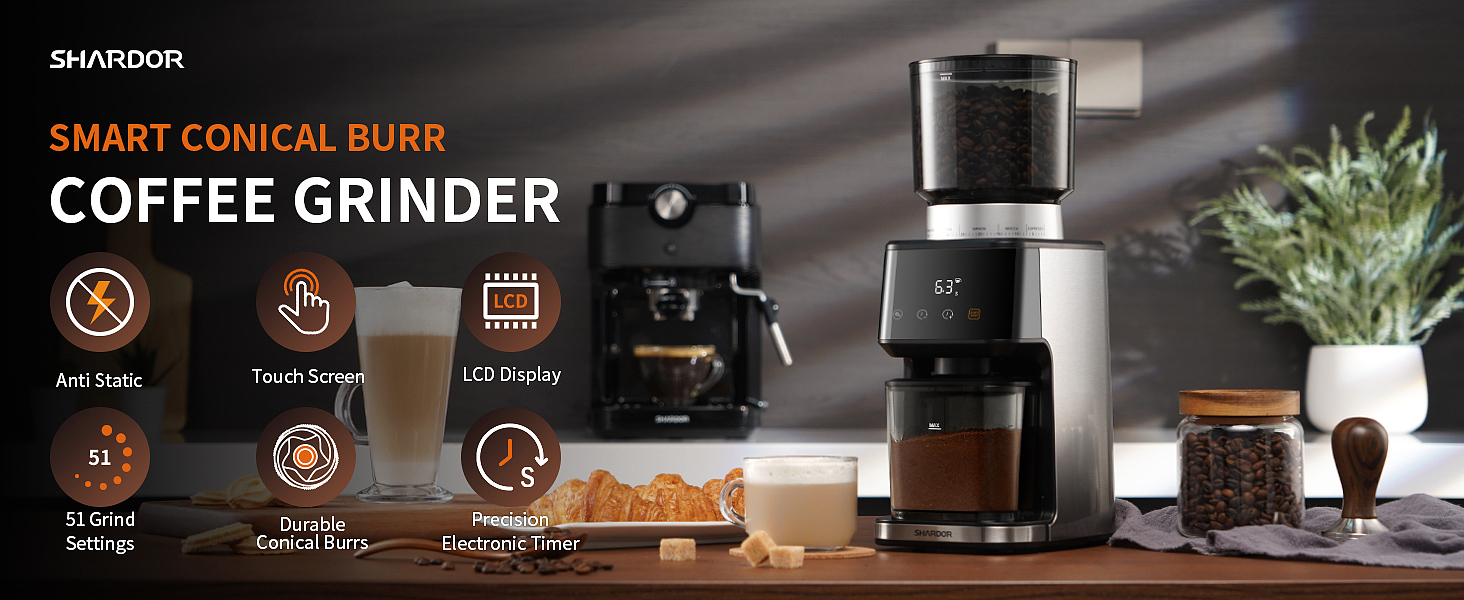
SHARDOR BD-CG015 Conical Burr Coffee Grinder
Most home coffee problems do not start with the beans or the brewer. They start with the grinder. A bag of specialty beans can only reach the cup through the particles it becomes, and the size, shape, and consistency of those particles decide how much flavor makes it into the water. This guide explains the science behind that process and shows how the SHARDOR BD-CG015 Conical Burr Coffee Grinder is built to control it, with its stainless steel conical burrs, 48 grind settings, anti-static technology, and precision electronic timer.
Why Grind Consistency Drives Flavor
Extraction happens when water dissolves soluble compounds out of ground coffee. The Specialty Coffee Association benchmark for a balanced cup sits between 18 and 22 percent extraction, with water held between 195 and 205 degrees Fahrenheit, or 90 to 96 degrees Celsius. Water can only dissolve what it can reach, and it reaches the outside of a particle far faster than the inside. This is why particle size matters so much.
A uniform bed of grounds gives every particle roughly the same surface area and the same distance for water to travel. Even extraction follows. A mix of powder and pebbles does the opposite. The powder over-extracts and turns bitter and astringent. The pebbles under-extract and leave the cup sour and thin. Burr grinders exist to collapse this gap. Two abrasive surfaces, called burrs, shear beans into particles of a chosen size. The distance between the burrs sets the result.
Blade grinders, by contrast, chop. They fling beans against a spinning blade and produce a chaotic spread of sizes, from dust to fragments. No brew method tolerates that spread well. Control the particles and you control the extraction.
What the Grinder Does Differently
This grinder uses stainless steel conical burrs to shear beans rather than chop them. Stainless steel resists wear, holds a precise edge, and resists corrosion from coffee oils. The conical shape means beans feed downward by gravity into the grinding zone, which reduces the chance of jamming and produces fewer fines than flat burr designs.
The burrs are paired with 48 grind settings, which run from the finest espresso grind to the coarsest French press grind. Each setting adjusts the gap between the inner and outer burr by a small increment, which gives the user fine control over particle size without needing to swap burrs or recalibrate.
The motor is a 150-watt unit that turns the burrs at low speed. Slower rotation means less friction heat at the burr face. Heat works against aroma because the volatile compounds that carry coffee's scent vaporize when warmed. A cooler grind preserves more of those compounds, so the grinder retains more of the coffee's natural aroma and flavor. Low speed also means less static electricity, which is the force that makes fine grounds cling to the chamber walls and fly out when the lid opens.

The Anti-Static Advantage
Static electricity is a persistent problem in coffee grinding. When beans are fractured, the friction between the burr and the bean generates an electrical charge. That charge causes fine particles to stick to plastic surfaces, fly out of the chamber, and coat the countertop. The grinder addresses this with upgraded anti-static technology built into the grounds chamber.
The anti-static treatment on the chamber walls reduces the charge buildup, so grounds flow smoothly into the container instead of clinging to the sides. This means less mess, less waste, and more consistent dosing. When every gram of ground coffee ends up in the chamber rather than on the counter, the ratio of water to coffee stays where the user set it.
Precision Timer and LCD Touchscreen
A 40-second precision electronic timer and the LCD touchscreen make it easy to dial in a repeatable dose. For espresso, where a single gram can change the shot time by several seconds, this level of control matters.
Grinding for a set time removes the need to weigh beans separately for most brewing methods, since the same duration grinds a consistent amount. For French press, where the standard ratio is 1:15 coffee to water, the timer makes it easy to grind the right dose without a scale.
Bean Hopper and Dosing
The grinder comes with a 9.7-ounce bean hopper, which holds roughly 275 grams of whole beans. That is enough for about 27 cups of coffee at a standard 10-gram dose per cup. The hopper has a locking system that keeps it securely attached during operation and prevents beans from spilling when the grinder is moved.
The hopper feeds beans into the burr by gravity. There is no auger or force-feed mechanism to crack beans before they reach the burr. This gentle feeding contributes to the uniformity of the grind because each bean enters the burr at a similar orientation and speed.
Keeping the Grinder in Fresh Shape
Coffee oils do not age well on metal and plastic. Left on the hopper, the grounds chamber, or the burr faces, they oxidize and turn rancid, and that stale taste shows up in the next cup no matter how fresh the beans are. That is why this grinder is built to come apart. The hopper, the grounds chamber, and the internal burr all detach for cleaning, and a built-in brush is included for the everyday rhythm of it: the brush slides into the grinding chamber and sweeps away the residual grounds that cling to the burr and chamber walls between sessions. For the occasional deeper clean, the burr itself can be removed and washed with warm water; dried thoroughly before reassembly, it stays rust-free.
Over time, that cycle of quick brushing and periodic deep cleaning is what keeps the grinder producing fresh-tasting coffee and quietly extends the life of the burrs.
Dialing the Grind to Your Brew
The 48 settings span from the finest espresso grind to the coarsest French press grind, and the range maps naturally onto how each brew method wants its coffee. Espresso lives at the fine end, where the grinder produces a powder-like grind that creates resistance to water flow. The fine particles extract quickly, which is what the shot needs, since espresso typically brews under 9 bars of pressure in 25 to 30 seconds. At the other end of the dial, French press wants the coarsest settings: a coarse, even grind that can take a 4-minute steep without over-extracting, and coarse particles that part cleanly at the press filter. Pour over and drip live in the middle of the range, and a medium grind there balances extraction speed against flow rate, with the exact setting shaped by the filter's geometry and the brew time you are chasing.

Comparing Conical and Flat Burrs
Conical burrs, like those in the grinder, have a cone-shaped inner burr that fits inside a ring-shaped outer burr. Beans are fed from the top and ground as they move downward. This design is quieter, generates less heat, and produces fewer fines than flat burrs.
Flat burrs are two discs that face each other. Beans are fed from the side and ground between the discs. They can produce a more uniform particle size distribution at the finest settings, which is why some espresso-focused grinders use them. However, they are louder, generate more heat, and are more expensive to manufacture.
For home use, where noise and heat matter more than the last few percentage points of extraction uniformity, conical burrs are the practical choice. The grinder's conical design is well-suited to the range of brew methods most home users practice.
Motor Power and Grind Speed
The 150-watt motor in the grinder is sized for home use. It provides enough torque to grind dense, light-roasted beans without stalling, but it is not so powerful that it generates excessive heat. The low-speed rotation keeps the burr temperature low and preserves aroma.
Higher-powered motors, found in commercial grinders, can grind faster but also generate more heat. For home use, the grinder's motor is more than sufficient, and a single dose grinds quickly enough for a morning routine.
Noise Considerations
All burr grinders produce noise, but conical burr grinders are generally quieter than flat burr grinders. The grinder's low-speed motor and conical burr design contribute to a noise level that is tolerable in a home kitchen. The exact decibel level is not published for this model.
Noise is a function of motor speed, burr material, and the sound-dampening properties of the housing. The grinder's plastic housing absorbs some of the vibration, and the low motor speed reduces the whine that high-speed motors produce.
Build Quality and Design
The grinder has a compact footprint that fits under most kitchen cabinets. The black finish resists fingerprints and matches common kitchen aesthetics. The LCD touchscreen is positioned at a comfortable viewing angle, and the buttons are responsive to light touch.
The detachable design means the grinder can be stored compactly when not in use. The hopper lifts off, the grounds chamber slides out, and the burr can be removed for cleaning. This modularity is a practical advantage over grinders with fixed components that are difficult to clean.
Who Should Consider the Grinder
The SHARDOR BD-CG015 is a practical choice for home coffee drinkers who want consistent grounds without the complexity or cost of a high-end espresso grinder. Its 48 settings cover the full range of brew methods, from espresso to French press, and the anti-static technology keeps the counter clean.
It is well-suited to households that brew multiple styles of coffee. The same grinder can produce a fine grind for espresso in the morning and a coarse grind for French press in the afternoon, with a simple turn of the adjustment ring. The precision timer ensures that each dose is consistent, so the user can repeat a good cup without weighing beans every time.
For users who primarily drink drip coffee or French press, the grinder offers more settings than needed, but the extra range does not hurt. For users who want to explore espresso without investing in a separate grinder, the finest settings produce a grind that works in a consumer espresso machine, though it may not match the consistency of a dedicated espresso grinder with stepless adjustment.
Wrapping Up
This grinder delivers the core benefits of burr grinding, uniform particle size, adjustable settings, and low heat generation, at a price that fits most home coffee budgets. Its 48 settings, anti-static chamber, precision timer, and detachable design make it a versatile tool for anyone who takes coffee seriously.
The grinder does not replace a scale for precise dosing, and it lacks the stepless adjustment of a commercial espresso grinder. But for the home user who wants to improve their coffee without overcomplicating the process, the grinder is a solid choice. The conical burr design, low-speed motor, and anti-static technology address the most common complaints about home grinders, and the 48 settings provide enough range to experiment with different brew methods.
Investing in a good burr grinder is one of the most cost-effective upgrades a home coffee drinker can make. The difference between a blade grinder and a burr grinder is immediately visible in the cup, and the difference between an inconsistent burr grinder and a consistent one is just as apparent. The grinder sits in the sweet spot of price, performance, and ease of use.
SHARDOR BD-CG015 Conical Burr Coffee Grinder
Related Essays
