Anti-Static Conical Burr Grinder: What Changes in the Chamber

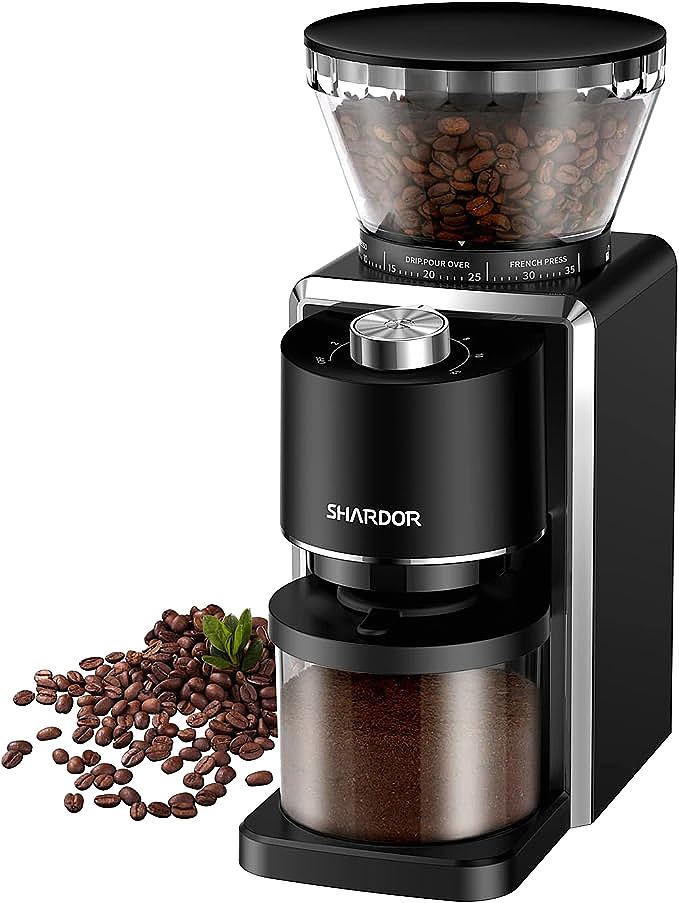
SHARDOR Conical Burr Coffee Bean Grinder
The mess arrives a second after the grind stops. Lift the catch cup and a brown haze that was not there a moment ago has already dusted the counter, the scale, and the back of your hand. Most drinkers blame the grinder, or the beans, or their own rush. The charge sitting on the grounds is what put that dust in the air, and it starts building the moment the burrs bite.
Treat static as a housekeeping problem and the counter wins, because there is always more dust to wipe. Treat it as a charge problem and the fix moves inside the machine, to the chamber where grounds collect and to the materials that decide how the charge leaves. An anti-static conical burr grinder changes the morning at that point: charge and particle size are set in the same spot, before the water ever arrives.
Where the charge comes from in a coffee grinder
Two different materials rub together, one gives up electrons, and both walk away carrying a charge. Physics calls this the triboelectric effect, and a grinder repeats the experiment thousands of times per dose. Brittle bean fragments scrape across steel burrs, electrons trade sides, and the plastic of the catch chamber waits at the end of the path as a natural place for the charge to settle.
Air and roast decide how far the effect runs. Winter air and air-conditioned rooms hold little moisture, and dry air lets a charge sit on a particle instead of draining away. Darker beans spend longer in the roaster, come out drier and less dense, and surrender static more readily than a light roast does. A finer setting adds another layer, because smaller particles mean more surface area and more contact along the same pass.
Those charges cost more than they look. A small share of each dose can stay behind on the chamber walls and the chute, and on a 15 g dose that residue is heavy enough to pull a recipe off its target. The scale reads the beans that reached the cup, not the ones still clinging to plastic, so the ratio drifts while every number on the counter looks correct.
What an anti-static chamber changes about the mess
Charge needs somewhere to go, and an anti-static chamber gives it a short path out. Conductive elements in the grounds bin and a smooth exit route let the charge bleed off as the coffee falls, so particles land where they were aimed instead of leaping to the nearest wall. Material science does the quiet work: same beans, same grind, and a catch path that does not hold on to what passes through it.
A grinder built on that idea, the SHARDOR Conical Burr Coffee Bean Grinder, treats the chamber as part of the circuit rather than a bucket at the end of one. The listing credits the anti-static build with keeping grounds off the works and letting them flow smoothly into the cup, the outcome a daily brewer notices as less sweeping and a dose that arrives whole.
Even a well-behaved chamber leaves a little charge behind, and two habits close the rest of the gap. Let the grounds rest 5-10 minutes before you lift the cup, and the stray charge drains on its own; tap the cup against the counter and the last particles drop in with the rest.
What a wet spoon changes at the start of the grind
The spoon trick works on the beans instead of the machine. A single drop of water on the back of a spoon, stirred through a 15 g dose, adds just enough moisture to give the charge a path off the grounds before the burrs ever touch them. The grinder stays dry, the beans never get wet enough to matter, and the chamber has less work to do. The technique carries the name Ross Droplet Technique, and the habit takes a few seconds and costs one drop.
Why the burr set decides the particle spread
Static decides where the grounds land, and the cut decides what they are. A blade grinder shatters beans at random and turns out dust and chunks in one pile. Water pulls everything it can from the dust in the first seconds of a brew and leaves the chunks holding their flavor back, so a bed built from both extremes never extracts as one.
Conical burr grinders take a different route. A ridged cone turns inside a matching ring, and beans travel down a narrowing gap until every fragment meets the same teeth at the same setting. The cut happens at low speed, which keeps friction heat down, and lower heat leaves more of the volatile oils where they belong. Those oils carry the flavors that make a fresh grind worth the trouble, and heat removes them long before the water arrives.
The SHARDOR listing describes the same mechanics in its own words: a conical burr that turns at low speed to hold heat down and help the oils release.

The grind range, from espresso fine to French press coarse
On a conical burr grinder, the dial covers 48 settings, and the span stretches between a powder fine enough to slow an espresso shot and a coarse crush that suits a French press or a cold brew steep. Drip and pour-over sit in the middle, and the coarse end feeds a 40 g French press batch as easily as a single cup.
The spacing between settings keeps the dial useful. Wide gaps force a guess between cups that taste nothing alike, while a close spread lets you fix a fast pour with one notch instead of crossing past the target. Taste between brews, adjust a single step, and let the grind settle before you touch water temperature or ratio; those variables can wait their turn.
Setting the dose by time instead of by eye
Dose consistency starts earlier than the drip, at the timer. A precision electronic timer moves in 1 second increments up to 40s, and the LCD touchscreen shows the count, so a run can be set, read, and repeated instead of eyeballed. Pair it with a scale that reads to 0.1 g and each grind becomes a number you can reuse: same time, same weight, same cup.
Every recipe reduces to two weights. A pour-over may pair a 20 g dose with 300 g of water, while an espresso basket holds 17 g to 18 g and chases 36 g in the cup. Those targets pull different run times from the same hopper, and a 1 second step is fine enough to trim a dose without blowing past the mark.
Putting the routine together on a weekday
The pieces only matter if they survive a groggy Tuesday. Beans loaded the night before, a timer setting that already matches the basket, and a chamber that keeps its charge to itself: none of it asks for attention at 6:40 in the morning, which is the only test that counts.
A dry December morning with the SHARDOR grinder
Indoor air in December runs dry, and dry air is when static gets loud. The SHARDOR routine does not care. The hopper still holds most of the weekend bag, the timer still carries Sunday's setting, and the grind drops in a quiet stream while the kettle heats. The anti-static chamber never gives the grounds a wall to grab, so the dose lands whole, the basket weighs out clean, and the only cleanup left is the cup you were going to rinse anyway.
Keeping the burr path clear between bags
Grounds leave an oily film on every surface they touch, and that film turns stale in days. A dry brush through the chamber and the burr path once a week keeps last week's roast out of this week's cup, and the job takes two minutes, not a teardown. Keep water away from the burr set, since steel and moisture are a poor pair; a clean exit path matters more than a shiny one.
A clear path also keeps the grind honest. Dust packed around the burrs changes how beans travel through the gap, and a machine that cuts through a clear path repeats its output instead of drifting as the week wears on. The routine protects the one part that decides everything downstream of the hopper.
What the 9.7 ounce hopper changes about the week
Capacity sets how often the ritual repeats. The SHARDOR hopper holds 9.7 ounces of beans and locks into place, so it stays put while the burrs run and lifts off in one motion when the bag runs low. A full hopper also meets less air than a folded bag, and moving the refill to the start of the week keeps the weekday mornings moving.
Freshness follows the same clock as the charge. Whole beans keep their oils sealed until the burrs open them, and the window on flavor runs from that moment to the water. Grinding a dose right before the brew keeps the window short, which is the habit a timer and a full hopper make easy to keep.

What to settle before the first grind
A few decisions belong at the counter before the first dose. Pick the cup or the basket you plan to fill and work backward from it: fine for espresso, medium for drip, coarse for a press. A scale that reads in grams and a timer with fine steps matter as much as the burr, because those touch points hold the routine together when a new bag changes everything else.
The SHARDOR Conical Burr Coffee Bean Grinder lists at $69.99 and shows In Stock under ASIN B0CKYZLK9B. A conical burr grinder that settles the charge at the chamber settles the morning with it: beans stay covered, the dose gets a number, and the mess never gets a chance to start. That is the difference between a machine you clean up after and one that quietly finishes the job.
SHARDOR Conical Burr Coffee Bean Grinder
Related Essays

How a Conical Burr Grinder Turns Beans Into Even Grounds
SHARDOR CG9406-UL2: The Complete Coffee Grinder Guide

SOWTECH Static Free Coffee Grinder

The Ultimate Guide to Your Conical Burr Coffee Grinder

How to Choose a Burr Coffee Grinder: A Buying Guide

The Unseen World of the Grind, A Physicist Guide
The Soul of the Machine: Unlocking the Science and History of Your Espresso Shot
Cuisinart DGB-2W Grind and Brew Single-Serve Coffeemaker Review: Fresh Coffee Made Easy

The Engineering Behind the Brew: A Deep Dive into the La Reveuse Hipresso Super-automatic Espresso Machine