Hand Pump Espresso Pressure: A Portable Brewing Guide
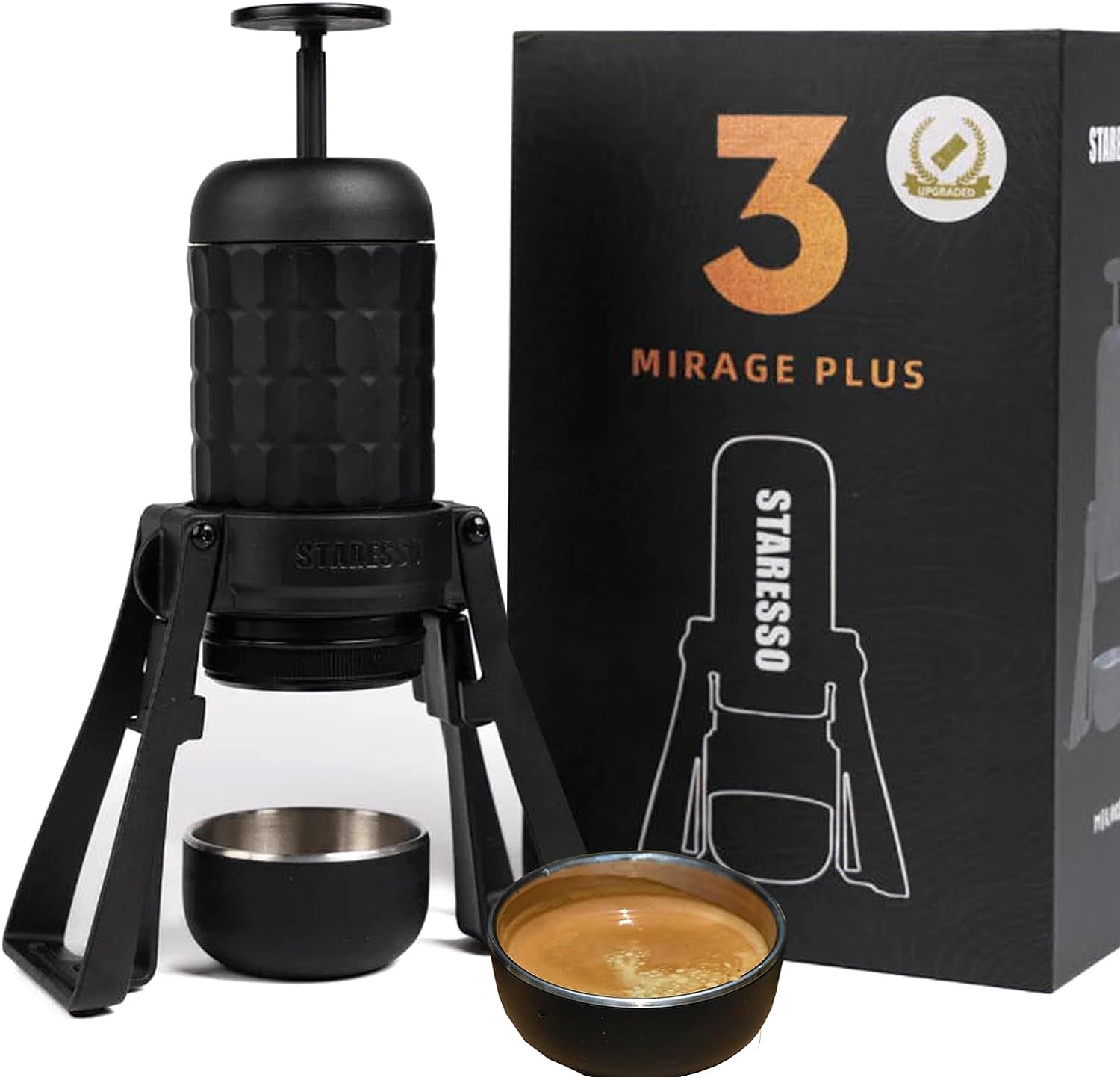
STARESSO Sp300 Plus Portable Coffee Maker
A hand pump espresso maker asks your arms to replace a motor. The physics is simple. The execution is not. This guide walks through how manual pressure builds stroke by stroke, why the shape of the pressure curve matters more than the headline bar number, and where this brewer sits in a travel brewer shelf that runs from $15.99 pocket pumps to $496 spring driven presses.
The curve no listing reveals
Read the listings and every manual brewer promises a number. Fifteen bar. Eight bar. Twenty bar. None of those numbers tells you what the pressure does over the course of a shot.
A hand pump espresso pressure curve has three phases. The first strokes fill the chamber and saturate the puck. Pressure sits low, often under 3 bar, and carbon dioxide escapes from the fresh grounds without fighting the incoming water. The middle phase is the peak. The piston bottoms out against a nearly full coffee bed and the gauge, if the machine had one, would read its maximum. The final phase is the fall. Water level drops, the bed compacts and then cracks, and pressure decays toward ambient while the last of the liquid leaves the cup.
That falling tail is not a defect. Italian lever operators have exploited it for decades. The later part of a shot pulls the harshest compounds, the dark bitterness that sits behind sweetness. A peak that collapses gently means the tail runs soft. A pump machine holding nine bar flat drags those compounds out at full force the whole way.
Segmented hydraulic extraction on the STARESSO Sp300 Plus Portable Coffee Maker
The maker calls its mechanism segmented hydraulic extraction. The term sounds like a patent filing, which it is. For the STARESSO Sp300 Plus Portable Coffee Maker the physical description is still short: two pistons and one sealed chamber doing the work a boiler and pump do at home. Each downward stroke of the top piston drives a fixed small volume of water into the brewing chamber. The 24 gram basket resists the flow. Water is nearly incompressible, so the only direction left for the energy is up. Stroke after stroke accumulates until the chamber sits at the 15 to 20 bar range the maker lists.
The force arithmetic is worth checking. A two centimeter piston has an area of about 3.14 square centimeters. Ten kilograms of force spread over that area produces roughly 3.1 bar, so reaching 15 bar takes about 48 kilograms of downward push. Two palms leaning on a vertical top press put most of a body's weight behind every stroke, which is what makes that load reachable on a tabletop. The vertical top press exists for exactly this reason. You lean over it, gravity assists the last strokes, and the segmented stages spread the work across the whole press instead of one brutal slam.
Compare that with the hand pump in the Minipresso NS at $46.90, which advertises eight bar for OriginalLine pods, or the STARESSO Classic at $59.49, which reaches 15 to 18 bar but with a 10 to 12 gram basket and an 80 milliliter tank. The Sp300 pairs its pressure band with the largest basket in the manual group at 24 grams and a 180 milliliter tank. That is one true double shot or two singles from a single load of grounds, without reloading.
Why 15 to 20 bar matters away from a cafe
The nine bar cafe standard assumes a flat burr grind, water held at 93 C (200 F), and a puck that has had time to degas. None of that holds in a hotel room or a car trunk. A hand grinder produces a wider particle spread. The coarse tail of that spread lets water slip through fast, and at nine bar the shot would run short, sour, and thin.
Running the peak higher to 15 or 20 bar compensates. The extra driving force is the whole point of the higher band away from a cafe: it pushes water through the loose bed with enough velocity to reach a workable extraction yield before the water cools. The maker quotes the 18 to 22 percent gold band that the Specialty Coffee Association treats as the target. Water temperature is the other gap. Without a boiler, tank water loses heat to the metal chamber on every stroke. A higher peak shortens the time the water spends below its ideal window, so the extraction finishes before the cup goes flat.
The result will not match a cafe pull note for note, and it is not supposed to. The goal is a clean, sweet shot with real crema, three thousand miles from the nearest espresso bar.
Fresh grounds release carbon dioxide under pressure. With little pre-wetting, that expanding CO2 punches channels through the puck, sending water around dense zones and through loose ones at once. The result reads as sour in under-extracted pockets and bitter in over-extracted pockets. Controlling the first strokes to around 1 to 3 bar for a couple of seconds lets the bed saturate and lets much of that gas escape before full force arrives. In practice that means a slow, deliberate start rather than slamming from the top. The SCA gold window sits between 18 and 22 percent extraction yield; go under 18 percent and a shot reads thin and sour, go over 22 percent and it trends toward bitter and astringent. For water, the workable range is 90 to 96 C (194 to 205 F). At 77 F inlet water, without a boiler, metal mass pulls heat down quickly, so finishing before the temperature drops becomes part of the timing problem as much as the pressure curve itself.
For the mechanism, a 2 cm diameter piston gives about 3.14 cm2 of area. With roughly 10 kgf spread over that area the equivalent is about 3.1 bar (1 kgf/cm2 ~ 0.9807 bar), so reaching 15 bar takes on the order of 48 kgf of downward force - an amount that becomes feasible with a vertical top press using body weight and both palms across segmented strokes. Basket capacity is 24 g with a 180 ml water tank. Folded footprint comes in around 3.2 by 4.3 by 7.4 inches at about 1 lb. Materials include food grade 304 stainless steel with a nano ceramic coating on the pump shaft claimed at roughly three times durability. Temperature targets stay in the 194 to 205 F (90 to 96 C) window, matching the SCA gold band of 18 to 22 percent extraction yield.
Materials that survive the road
A pump that hits 20 bar, folds in half, rides in a backpack, and gets washed in a sink after every shot needs parts that degrade slowly. It uses food grade 304 stainless steel for all metal parts, the same grade found in surgical instruments and kitchen prep surfaces. The flexible seals use silicone at the baby bottle safety level, which means no plasticizers migrating into hot coffee. The pump shaft carries an aerospace grade nano ceramic coating that the maker claims triples surface durability against wear.
The coating earns its place. A plain steel piston sliding through a polymer sleeve shows wear within months of daily use. The ceramic layer resists both abrasion and the corrosive bite of coffee oils, so the seal stays tight and the pressure does not bleed off between strokes.
The body separates from the stand. Every component detaches for a full rinse under the tap. A silicone stability pad keeps the brewer planted while you press. Folded, it collapses to roughly the footprint of a large water bottle, about 3.2 by 4.3 by 7.4 inches and around one pound.

The three camps on the travel espresso shelf
The shelf splits three ways. Manual ground brewers need no battery and no outlet. Electric travel machines add a cell, a heating element, and a pump motor. Capsule compatible manual devices cover the convenience camp for pod drinkers.
The manual ground camp spans the eefaYIYIFA 3-in-1 at $15.99, a pocket grinder and pump in one body, up to the Piefeak at $496.53 with its spring driven pressure curve. Between them sit the Minipresso GR at $46.90 with a 50 milliliter hand piston and no advertised bar rating, the Classic at $59.49, and it at $84.65 with its 24 gram basket and 180 milliliter tank.
The capsule camp holds the Minipresso NS at $46.90 with an eight bar piston for Nespresso OriginalLine pods, the NS2 at $54.90, the HIBREW H4D at $29.99 with a built in cup and a sixty second brew claim, and the In My Bathroom hand pump at $49.95, which pairs a built in cup with a separate ground basket so it covers pods and loose coffee alike.
The electric camp trades weight for one button convenience. The OutIn Nano at $149.99 weighs 670 grams and heats 1.7 ounces of 77 F water to 198 F in about 200 seconds on a 2500 mAh battery, roughly five hot shots. The zxfcfo 3-in-1 at $59.99 carries a 7500 mAh cell for about four cold start brews and accepts ground coffee plus pods over USB C. The Safashy H520 at $59.99 heats 100 milliliters of cold water to 199.4 F in three to four minutes on 7800 mAh. The obecilc 3-in-1 at $39.70 lists 20 bar with an LED temperature and battery display. The kejector machine at $50.99 matches that 20 bar headline on a 7500 mAh cell and heats 80 milliliters to 194 F in about five minutes behind a single button.

Each electric device adds three failure modes. A battery that degrades. A heating element that scales. A pump motor that can stall in the field. The manual this brewer deletes all three. It needs hot water, and that is the whole list. A campfire kettle, a hotel flask, a thermos on a road trip, all of them work.
One caveat on the bar numbers. Every listing in the field, manual or electric, quotes the peak pressure at the pump, not the pressure that reaches the brew head. A 20 bar electric at $59.99 and a 15 to 20 bar manual at $84.65 can carry the same headline number and still produce different cups.
What the hands learn that the sensor cannot
The first three shots will not look like cafe espresso. Grind size, tamp force, water temperature, and stroke pace all need a short calibration period. There is no dial to turn. The piston talks through the palm. A fast drop in resistance means the grind was too coarse. A stiff, barely moving shaft means it was too fine. Once the stroke settles into an even give, the hand pump espresso pressure curve is doing its job.
That feedback loop is what no budget sensor suite on an electric machine matches. The machine does not know when the coffee is done. Your hands do. You watch the stream thin from syrup to tiger stripe to pale spritz and you stop the press on time, every time, because you felt the bed give way two strokes earlier.
A few calibration numbers come straight off the listing. Water in the 194 to 205 F window, which is 90 to 96 C. A dose up to 24 grams in the basket, water up to 180 milliliters in the tank of the STARESSO Sp300 Plus Portable Coffee Maker. Pre-infusion, in this context, is simply the first two slow strokes that wet the puck before the hard ones arrive.

Where this brewer earns its price
At $84.65 it does not compete with the $15.99 pocket pump on price, and it does not try to. It competes on basket size, tank volume, and the folding form factor. The 24 gram basket is the largest in the manual ground camp, which means a genuine double shot instead of two singles loaded twice. The 180 milliliter tank covers both shots without a refill. The separable body and stand mean the whole unit washes in a hotel sink in under a minute.
Electric rivals buy convenience with weight, battery cycles, and a heating element that will one day fail. The manual machine asks for arm work and nothing else. For a traveler who already carries a thermos of hot water, the trade is favorable.
For the buyer who wants one device that works in a hotel room, at a campsite, and on a desk Monday morning, the hand pump espresso pressure path is the simplest one on the shelf. No charging cable, no descaling cartridge, no pump to service. Just hot water, ground coffee, and your own hands.
On the competitive set, the manual ground camp ranges from the eefaYIYIFA 3-in-1 at $15.99 up to the Piefeak at $496.53. Between them sit the Minipresso GR at $46.90 (up to 50 ml, no advertised bar rating), the Classic at $59.49 (15-18 bar, 10-12 g basket, 80 ml tank), and the unit in question at $84.65 with a 24 g basket and 180 ml tank. Capsule manual options include the Minipresso NS at $46.90 (8 bar for Nespresso OriginalLine), the NS2 at $54.90, the HIBREW H4D at $29.99 (built-in cup, ~60 s brew claim for pods/ground), and the In My Bathroom hand pump at $49.95 (built-in cup, ground + pods). Electric travel brewers include the OutIn Nano at $149.99 (670 g, 2500 mAh, heats 1.7 oz from 77 F to 198 F in ~200 s, ~5 hot shots), the zxfcfo 3-in-1 at $59.99 (7500 mAh, ~4 cold-start brews), the Safashy H520 at $59.99 (7800 mAh, heats 100 ml cold water to 199.4 F in 3-4 min), the obecilc 3-in-1 at $39.70 (20 bar, LED temp/battery), and the kejector at $50.99 (7500 mAh, 20 bar, heats 80 ml to 194 F in ~5 min).

STARESSO Sp300 Plus Portable Coffee Maker
Related Essays

Portable espresso maker: how the X-Press58 handles 9 bars on the road
