Mecity KC101 Guide: The Numbers Behind a Single-Serve Cup
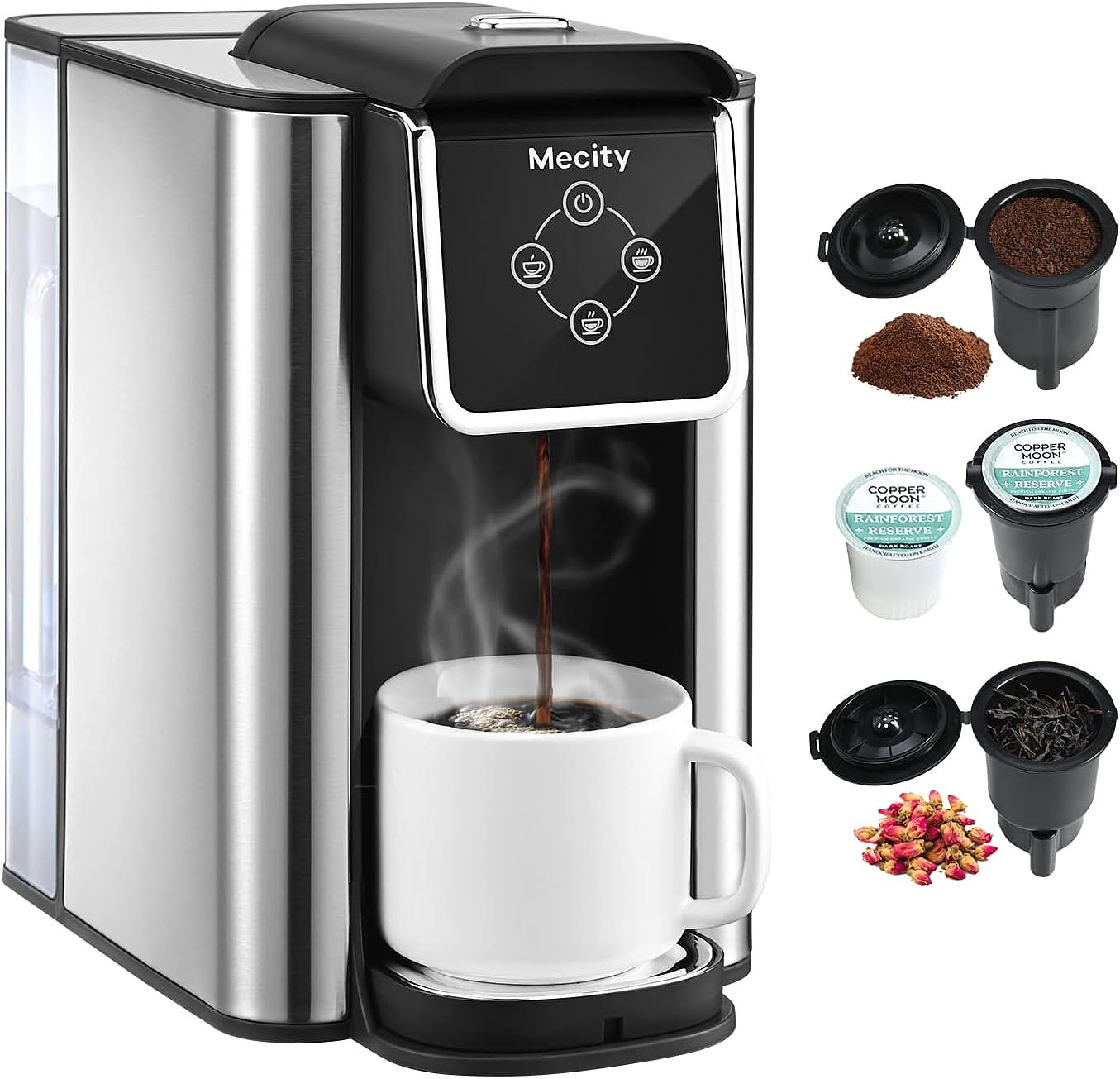
Mecity KC101
Mecity KC101 Coffee Maker, A Fast Track to a Repeatable Cup
The Mecity KC101 is a single-serve coffee maker that folds three brew paths into one body, a K-cup capsule path, a ground or instant coffee path, and a loose-leaf tea path, and all three run through one 1150 W brewing loop. At $59.99 the question is not the badge on the front, it is whether cup size, dose, and brew time land together so the cup comes out the same every morning. The listing supplies the hard numbers this guide works from: 6, 8, and 10 oz cup buttons, a removable 50 oz reservoir, a 60 to 100 second brew, and a body 6.3 in wide by 10.6 in high.
Three paths run on one loop
Every pour is a variation on a single loop: heat the water, push it through the coffee, stop at the set volume. The capsule path takes a sealed K-cup and runs one of three volumes, 6 oz (177 ml), 8 oz (237 ml), or 10 oz (296 ml). The ground path takes your own dose in the filter basket. The tea path uses the three filters inside the machine, so loose leaf does not need a kettle on the side. The shared loop is the reason learning one path teaches the others. What the machine does not carry is a grinder: the listing describes capsules, ground coffee, and tea, so whole-bean brewing is a separate job with separate equipment.
The temperature window does most of the work
Brew water temperature decides more of the cup than the badge on the box. The working band for drip-style brewing runs from about 90 to 96 deg C, and the middle of that band is the safe target: hotter water toward 100 deg C drags out bitter compounds, cooler water below 90 deg C leaves the cup flat and thin. Mecity does not publish a brew temperature for the KC101, so treat the band as the target you check rather than a promise on the box. A probe thermometer in the first cup tells you where the machine settles in practice, and that reading is worth more than any spec sheet claim.
Dose is the strength knob
Dose is the most movable number, and on a single-serve machine it sits between 5 g for a light cup and 7 g for a stronger one. The ratio that follows is not one figure, because the cup size moves too: 7 g into the 6 oz cup lands near 1:25, while 5 g into the 10 oz cup is close to 1:59. A coarse ground bed slows the pull and a fine capsule grind runs faster, which is why the listed 60 to 100 second window is the clock worth watching. A cup that runs well past 100 seconds points to an overloaded basket or too fine a grind. Six grams into the 8 oz cup, about 1:40, is the middle setting that suits most households without a scale on the counter.

The footprint the counter has to give
Single-serve means a small body, and the listing puts this one at 6.3 in wide and 10.6 in high, with clearance for a cup up to 3.7 in wide and 6.3 in high. The reservoir is removable, holds 50 oz (about 1.5 L), and the listing rates it at 8 drinks before a refill. If you want a cup to stay hot, plan for a pre-warmed mug: no warming plate is listed for the KC101, the tank is BPA-free plastic, and the machine is built to brew and stop.
The cup cost works out small
A 250 g bag at $14 gives about 35 doses of 7 g, which puts a cup near $0.40 of coffee against $5 to $6 at a cafe. One cup a day for a year is roughly $146 of beans against about $1,825 of shop bills, so the $59.99 machine pays for itself inside the first month of the switch rather than over a couple of years. The arithmetic is different on the capsule path: a pod at $0.75 to $1.00 costs about twice the ground route per cup, and that gap, not the machine, is the number that repeats every morning.
Why single-serve beats a full pot
The format wins on waste. A 7 g dose pulls one cup, so the 6 to 10 oz range is what you drink rather than what a pot makes and leaves standing. A household that drinks one cup a day wastes none of the dose, and the 50 oz reservoir plus the 6.3 in footprint are what let the machine sit in a narrow gap of counter instead of owning a corner. The limit is the reservoir, not the number on paper: eight drinks before a refill covers a normal day for most single-cup households, and the refill is a lift-out tank rather than a trip to the sink with the whole machine.
What the sheet adds up to
Three paths, one loop, a 5 to 7 g dose against a 6, 8, or 10 oz cup, and a 60 to 100 second brew are the offer of a maker at $59.99. The 6.3 by 10.6 in body, the removable 50 oz reservoir, and the $0.40 cup are the numbers to plan around, and the descale routine is the one maintenance item the manual asks for: when the medium cup and start buttons flash, pull the pod and run six cups of hot water through the machine. If the household drinks one cup a day, the beans pay for the machine in the first month.

Reading the brew numbers
Specs in one place for the Mecity KC101: a 5 to 7 g dose, cup buttons at 6, 8, and 10 oz (177, 237, 296 ml), a 1:25 to 1:59 ratio depending on dose and cup, a 60 to 100 second brew, 1150 W at 120 V, and a 50 oz reservoir rated for 8 drinks. The tank and piercing needle are BPA-free, the filter basket and drip tray lift out for washing, and the body measures 6.3 in wide by 10.6 in high. The ratio spread is the whole skill the format asks of you: pick the cup, pick the dose, and the same cup comes out pot after pot.
Pod or ground: the cost per cup on this unit
A capsule near $0.75, a common shelf price, lands at roughly double the $0.40 ground route, and a $1.00 pod is two and a half times it. The gap is packaging and portioning rather than quality: on this machine both paths use the same 60 to 100 second loop and the same 50 oz reservoir, so the switch costs nothing beyond trading the filter basket for a pod holder. One cup a day at $0.75 pods is about $274 a year against $146 for 7 g doses from a $14 bag; at three cups a day the difference passes $380. Ground wins on cost, pods win on cleanup and on the cup being identical every time, and the machine is the only part of the decision you pay for once.
Mecity KC101
Related Essays
The Little Engine of Flavor: Deconstructing the Science and Soul of the Bialetti Moka Pot
Hamilton Beach 49980A: The Versatile 2-Way Coffee Maker for Every Need
Engineering the Morning: The Fluid Dynamics of 5-Cup Drip Extraction

Hamilton Beach FlexBrew 49948: Your Guide to Perfect Single-Serve Coffee

Mixpresso 12-Cup Drip Coffee Maker: The 60 Ounce Pot

Alessi DC06/3 Moka Pot: Authentic Italian Espresso
Rae Dunn 2-in-1 Coffee Maker, Two Brew Paths

IMUSA Electric Espresso Maker: 6 or 3 Cup Guide

Diguo Belgian Balance Syphon: Complete Brewing Guide
