The Physics of Density: Engineering High-Power Espresso in Micro-Spaces

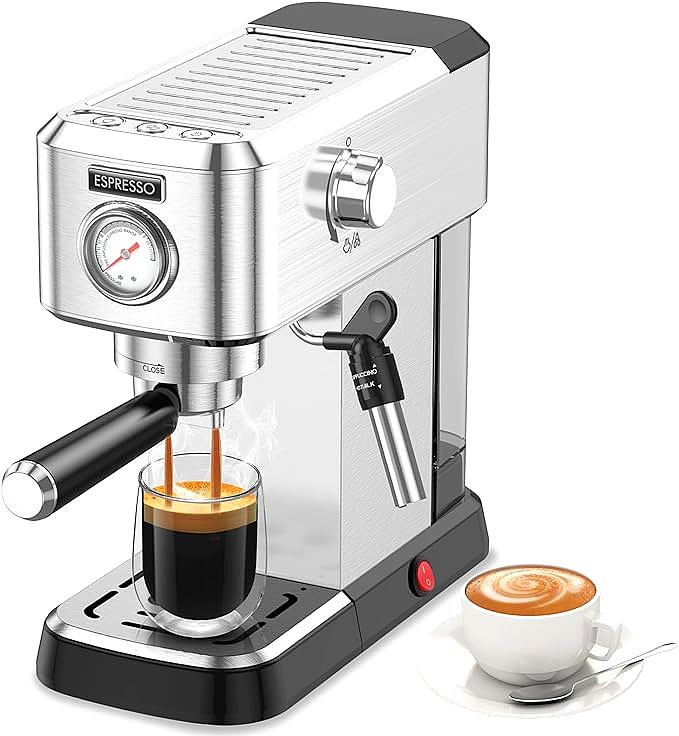
CASABREWS CM5418
Most kitchens do not have a spare corner for a coffee bar. What you usually get is a strip of counter under the cabinets and one outlet, and the machine that has to live there cannot be the size of a microwave. A compact espresso machine guide is really a question of physics: whether you can run a high pressure brewing system in a small case without sacrificing the things that make espresso taste like espresso. The idea worth holding onto is that power and size are not the same thing. A machine that wins a tight space is the one that packs a surprising amount of output into a small body, and that trade shows up in the numbers on the spec sheet.
This piece is built around the CASABREWS CM5418 as its example, a small stainless steel espresso machine with a 20 bar Italian pump, a 1350 W boiler, and a built in pressure gauge on the front panel. It sits in the upper half of the compact crowd by price, and its specs make the physics easy to follow. I will walk through what density does inside the portafilter, why the famous 20 bar figure is mostly marketing, how a small machine hides real heating power, and how you tune a tight setup for good shots.
What Density Means in a Portafilter
Coffee is not a uniform ball. Ground coffee is a pile of particles with air trapped between them, and before you can brew you press that pile into the basket and pack it down. The packed mass becomes the thing the water has to push through. The harder you pack it, the less room the water has to find a gap, and the more it has to split up and force its way through every particle at roughly the same rate. This is why density matters more than most home baristas believe.
A loose puck lets the water find one weak channel and run through it fast. That path over extracts and turns bitter while the rest of the bed barely gets touched, and you get a shot that is harsh and thin at the same time. A well packed, even puck resists that shortcut and forces the water to work across the whole surface. The tradeoff is flow. Pack it too dense and the water slows down, the shot sputters, and you drown in under extraction. The sweet spot is a firm but even bed that gives a steady pour in about 25 to 30 seconds for a standard double shot.
Most compact machines, this one included, come with a tamper and a small scoop, and that is enough to learn the difference. Dose 18 grams into the basket, level it gently, and tamp with steady downward pressure. Watch the flow in the first few seconds. A thin, fast, pale stream that slows to drips means the bed is too loose or the grind is too coarse. A shot that never starts, or that comes out as a brown trickle after a long wait, means the bed is too tight or the grind is too fine. The gauge on the front of the CASABREWS CM5418 is useful here because it shows you what the pump is doing instead of making you guess.
The 20 Bar Myth and the Real Brew Pressure
Here is where the spec sheet lies to you, and it helps to know exactly how. The pump on this machine is rated at 20 bar, which is roughly 290 psi, and that number is printed in bold because it sounds impressive. But espresso is not brewed at 20 bar. Almost no machine brews at its maximum pump pressure, and for good reason: water pushed through a puck at 20 bar moves so fast it tears through the coffee, stripping harsh compounds and producing a thin, bitter shot. The industry standard for a balanced extraction is around 9 bar, roughly 130 psi, and that is the pressure a well designed machine holds at the puck.
So how does a 20 bar pump give you 9 bar at the basket? It does not, directly. The pump creates a high maximum pressure, and the machine then limits what reaches the puck. Many compact machines use an over pressure valve that vents excess pressure so the brew stays near 9 bar. Others rely on the resistance of the puck itself: the pump pushes, the packed bed pushes back, and the two meet somewhere in between. The machine gives you a gauge so you can see where that meeting point lands, which is a useful feature in this price range.
The practical takeaway is simple. Do not buy a machine because it says 20 bar and another says 15 bar. Both numbers are maxima, not brewing pressures, and both are higher than the 9 bar you want. Buy the machine that lets you see or control what is happening at the puck, because that is what determines the taste.
How a Small Machine Hides Real Heating Power
A compact espresso machine guide has to talk about heat, because heat is the thing that gets squeezed when the case shrinks. Espresso wants water at about 90 to 96 degrees Celsius, and milk steaming wants a boiler that can keep making steam while you pour. A big machine can carry a large boiler and a big heater. A small machine has to do the same job with less metal and less space, and that is an engineering problem with a real answer.
The machine runs a 1350 W element off a 120 V circuit, which is the same wattage you find in many mid size machines. Wattage is not the same as capacity; a 1350 W element in a small boiler brings water to temperature fast, but it also cools down fast when you pull shots or steam milk. The advantage of a small boiler is recovery time. There is less water to reheat, so the machine gets back to brewing temperature quicker after a shot. The disadvantage is that you cannot pull shot after shot after shot without waiting, and you cannot steam a pitcher of milk for four lattes and then immediately brew without a pause.

A compact machine runs on this rhythm: pull a shot, wait a beat, steam milk, wait a beat, pull the next shot. Once you learn the cycle, it is not a limitation so much as a tempo. The machine also warns you about the one sequence you should not force. Do not brew coffee immediately after frothing milk, because the boiler is still hot and full of steam pressure, and the machine can go into overheating protection. Let it cool for a minute, and the lights stop flashing and the pump is ready again.
Tamping, Dose, and the 54 mm Basket
The standard home basket size is a good one for a compact machine because it gives you enough bed surface to make density matter without demanding a commercial level of dose. A medium fine espresso grind sits near 0.6 mm, and that is the starting point the basket in this class wants. A 54 mm double basket in this machine holds about 18 g of ground coffee, and that number is your anchor. If you underdose the basket, the bed is too thin, the water finds the weak path fast, and the shot runs pale and sour. If you overdose, the basket overflows, the puck hits the shower screen, and the water channels around the edges instead of through the bed.
Tamping is where most beginners lose the shot. The goal is not maximum force. The goal is a flat, even, compacted bed with no cracks and no tilted surface. A tilted tamp creates a dense side and a loose side, and the water always takes the loose side first. That is the most common cause of a shot that looks like it is extracting and tastes like it is not. A cheap tamper that fits the basket, a light distribution of the grounds with a fingertip or a small tool, and a firm press straight down are all you need.
The machine ships with a tamper that has a scoop on the other end, which keeps the workflow to one tool. That matters in a micro space, where you do not have room for a distribution station, a scale with a wide platform, and a separate tamper all laid out at once. Fewer tools on the counter also means fewer things to put away before the machine fits under the cabinets.
Temperature Stability in a Small Case
A small machine with a single boiler is always a negotiation between brewing temperature and steaming temperature. Brew a little cooler than ideal and the shot tastes sour and thin. Steam with a boiler that is a little wet and the milk comes out foamy instead of silky. This is not a flaw of compact machines; it is a property of single boiler design, and the way you manage it is sequence.
Pull your shot first, while the boiler is in the brewing range. Then steam your milk, knowing the boiler will climb toward steaming temperature. If you need another shot right after, give the machine a minute to settle back down. A machine like the Breville Bambino uses a different trick, a small thermojet heater that heats water on demand in about three seconds, which reduces the waiting but costs more than twice the price. The machine takes the simpler path: one boiler, one heater, and a rhythm you learn in a week of mornings.
The other temperature factor is the cup. A small machine in a small kitchen is often used in a small rush, and a cold porcelain cup will drop the temperature of a shot by several degrees within a minute. Rinse the cup with hot water from the steam wand or the hot water tap before you brew. It is a ten second habit that buys you a noticeably better cup, and it costs nothing.
The Steam Wand and Milk Texture
Steam is where compact machines used to give up the most, because a small boiler makes a small amount of steam and a thin wand tip makes a rough foam. The machine has a powerful steam wand, which lets you texture creamy, rich microfoam milk for latte art. The wand tip has multiple small holes rather than one big one, and that spreads the steam across more of the milk surface, which gives you finer bubbles and a smoother texture.
The technique matters more than the machine here. You want a pitcher with a pointed lip, cold milk, and the tip of the wand just below the surface at first to make a hissing sound that pulls air in. Then you lower the tip deeper to create a vortex that folds the foam into the liquid. Thirty to forty seconds for a small pitcher, until the pitcher is warm to the touch and the foam is glossy. If the foam looks like shampoo and the pitcher is too hot to hold, you went too long and the milk is scalded.

Tank Size, Footprint, and the Micro Space Workflow
The 34 oz water tank holds about 1 liter of water, which is enough for roughly eight to ten double shots before a refill. In a small kitchen that is a good number: it is enough for a morning of drinks for one or two people, and it is small enough to slide out and fill at the sink without wrestling the machine into position. A detachable tank matters more in a micro space than a big one, because you often cannot reach the back of the machine where the fill cap would be.
The footprint is the other half of the equation. At 12.3 inches deep, 5.5 inches wide, and 12 inches tall for 8.6 lb, this machine is narrow enough to sit beside a toaster and deep enough to take a standard cup on the drip tray without hitting the cabinets above. Measure the height under your cabinets before you buy anything, because a compact espresso machine guide is full of machines that are compact in width and still too tall for a low cabinet. Leave about 5 cm of clearance above the cup and behind the cord and the machine will live happily in the strip of counter you have.
The workflow in a small space is a loop: fill the tank, grind, dose, tamp, pull, steam, wipe, done. The faster you make that loop, the more you will use the machine, and the more you use it, the better your shots get. A machine that is hard to clean or annoying to refill will sit on the counter and gather dust, and the compact machine that is easy to use is the one that justifies its place.
How It Compares to Bigger Machines
It is fair to ask what you give up by going compact, and the answer is volume and flexibility. A bigger machine can carry a larger boiler and a built-in grinder, and it can pull shots back to back without a pause. It also needs more counter space and more money. The CASABREWS 3700 Essential is its sibling, with a larger 43.9 oz tank and about 20 dollars less on the price tag, and it makes sense if you brew for more than two people. The 3700 also runs a 1350 W boiler and a 20 bar pump, so the heating power is identical. The BYESHOP and the Neretva in the same compact class add digital displays, which are nice but not necessary once you learn to read a shot.
What the compact class gives up in volume it gives back in fit. A micro space does not need a machine that can cater a party. It needs a machine that can make two good drinks in five minutes and then disappear under the cabinets. The machine is built for that job: a 20 bar pump that hides a real 9 bar brew behind a gauge you can read, a 1350 W boiler that heats fast and recovers fast, a 34 oz tank that covers a morning, and a powerful steam wand that textures creamy microfoam milk for latte art practice.
Wrapping Up
A compact espresso machine guide really comes down to three numbers you can check on the spec sheet before you buy. The pump, which tells you the maximum the machine can hit but not what the shot runs at. The boiler wattage, which tells you how fast and how consistently it can stay hot. And the tank, which tells you how long you go between refills. This one, a $118.99 stainless steel machine with a 20 bar pump, a 1350 W boiler, a built in gauge, and a 34 ounce tank, is a good example of the compact approach. The 20 bar pump delivers 290 psi at maximum, the 1350 W boiler recovers in about 30 seconds between shots, and the brew band sits at 93 to 96 deg C with a 25 to 30 second pull.
Buy it for the tight counter and the single boiler rhythm, not for a big batch. If you are brewing for a crowd or you want the grinder built in, a bigger machine covers more, and it needs more room. For the small corner and the machine that quietly packs a lot of pressure into a small case, the compact 20 bar group is where a tight counter and a one person habit line up, and the example at that price earns its shelf space.
CASABREWS CM5418
Related Essays
How to Choose and Use a Compact Espresso Machine

CHULUX Slim Espresso Machine: 20-Bar Espresso for Your Home Kitchen