Shattering the Seed: The Hidden Fluid Dynamics of Particle Distribution

OXO Brew Conical Burr Electric Coffee Bean Grinder - 12 Oz, Silver
Most home kitchens hold a coffee grinder that was bought on impulse and has quietly underdelivered ever since. Beans go in, a metal disc rattles for a few seconds, and what comes out is a pile of rubble: a few whole pieces, a heap of fine dust, and a scatter of coarse fragments that will never extract cleanly. The pot tastes flat in the middle and sharp at the edges, because different particle sizes dissolve at different speeds. The fix is not a stronger motor. It is understanding what happens in the cup when you press the button, and the machine choice that controls the mix of sizes you end up with. A conical burr coffee grinder controls that mix at the gap, and that is why the cup comes out even instead of scattered.
What resists the blade
A coffee bean is not one solid thing. Inside the hard shell sits a dense body of collapsed cells packed with oils, sugars, and trapped gas. The shell itself is layers of dead, dried plant tissue that split along weak seams when hit hard enough, which is why the cracking sounds that travel through a hopper snap like dry twigs. Moisture changes how the seed breaks. Drier beans fracture into clean shards. Beans that have taken on humidity go soft and crumble into paste instead, and fine dust forms in quantity. Freshly roasted beans still hold pockets of gas near the center, so they split with a burst of small fragments and a puff of powder. All of this decides the particle mix your grounds will carry.
Roast level changes the break as much as moisture does. A dark, well roasted bean has a brittle, porous body that crumbles into many small pieces, while a light roasted bean is dense and tends to snap into a few large chunks. That is why the same grinder setting gives a wider spread with one roast than with the other, and why a dial that looked perfect last week can drift.
Two paths to shattering the seed
Blade grinders do the shattering by impact. A spinning disc at the bottom of the bowl whips the beans around, hammers them into the wall and into each other, until they snap. There is no fixed distance between the surfaces, so every fragment breaks at a different size. Run the machine longer and the same pile simply grinds finer, because the smaller pieces tumble back under the blade. That is why blade mills are measured in seconds rather than in settings. Time is the only dial.
Burr grinders do the job by compression. Two hardened surfaces that sit close together crush the bean between them as the burrs turn. The gap between the two surfaces is fixed at any chosen setting, so nearly every fragment leaves at about the same size. That is the core idea behind the OXO and most conical burr coffee grinders: a fixed gap produces a narrow band of particle sizes instead of a scatter. A conical burr coffee grinder holds that gap steady while the beans spiral through, so the cut stays consistent from the first bean to the last. The band stays tight because the surfaces shear the seed the way a pair of shears would, not the way a wall punch would.
The burrs and the gap
The OXO Brew Conical Burr Electric Coffee Bean Grinder - 12 Oz, Silver is the burr reference here. It grinds on 40 mm stainless steel conical burrs. Conical means the cutting surface is a cone that turns inside a ring. The two surfaces meet along a short edge at one angle and fall away at the other, so a bean is sheared gradually as it spirals inward. Forty millimetres is a mid sized burr, small enough for the counter and large enough to give the grounds time to clear the gap before they settle. Steel is what keeps the cut clean, because softer burrs round over with use and let particle sizes creep. Because the gap is the only variable, the machine can offer a range without losing accuracy. The OXO carries 15 marked settings plus 43 micro-adjustments between them, so the travel from the finest espresso cut to the coarsest French press cut is one long, smooth slide rather than a handful of big jumps.
The hopper holds up to 12 oz of beans, which works out to about 340 g, enough for a week of single cup brews. That capacity matters for the distribution question. More beans in the cup at once means more of them fall into the gap in a single burst, and a pocket of fines can build up near the burrs if you only grind a spoonful. A steady quantity keeps the pattern even.
Hardness is what separates a burr that lasts from one that dulls. A stainless steel burr holds its cutting edges for years of daily use, while a ceramic burr resists heat but chips if a small stone slips in with the beans. The cone shape also slows the feed, so the beans are sheared rather than slammed, and fewer whole fragments escape the gap.
Where the grounds flow
Once the particles clear the burrs they have to move somewhere, and this is where the fluid behaviour of the powder takes over. Coffee grounds behave like a very thin, dry snowpack. They will not slide freely past one another when the pieces hold onto each other through static charge and the oils they carry. That is why a fresh batch clumps, and then collapses when you tap the container. A clean chute and a cup you can lift away both let the powder shed as it lands instead of piling into one ridge.
The spread you can feel in the cup comes straight from the gap. A narrow gap gives one band of sizes, and that band is what makes extraction even, because the water meets similar surfaces at the same rate. A wide scatter, the kind a blade mill throws off, means the water grabs the fine dust first and the coarse pieces last, so by the time you pour, the pot has been pulling different things all along. That scatter is why a blade ground tastes uneven even when the recipe is exactly right.
Matching the spread to the brew
The particle band has to fit the brew time. Fine grounds show a large total surface and dissolve quickly, which suits a short, pressurised pull. Coarse grounds show little surface and need a long steep. The settings on a conical burr coffee grinder cover both ends and the middle. The fine detours are for a short cup, the coarse detours for a long steep or a cold brew, and the middle settings for a drip. Slide the burrs a step toward coarse and the extraction slows, letting more of the sugars come through before the late bitter compounds. The dial remembers your last setting, so you grind without resetting the gap each morning.

The blade alternative
At the other end of the counter sit the blade mills, and the distance between them and the burrs is where the particle difference really shows. The Aromvel runs on a 180 W motor turning near 30,000 rpm. It lists coarse at 12-15 s, medium at 20-25 s, and fine at 35-40 s. You are told to stop at forty seconds because the bowl is sized for one or two cups, roughly 65 g, and running it longer only piles the fines into a slurry that a drip filter will choke on.
The BLACK+DECKER one touch model runs a 150 W motor in a two thirds cup bowl, aimed at the same single press operation. Hamilton Beach and other budget blade mills put out similar blades at similar prices, and none of them gives you a gap you can fix. The only way to move from fine to coarse is to change how long you hold the button down. That is a trade, not a setting, and the particle spread always runs wider than it will on a conical burr coffee grinder with a set gap. By ASIN the row lines up: OXO B07CSKGLMM on burrs, Aromvel B0GV3TTHJJ, BLACK+DECKER B07Z8G97PY, and Hamilton Beach B005EPRFKO on blades.

Why the difference shows up in the cup
The gap is not a luxury detail. It decides whether your extraction is steady or scattered. On a conical burr coffee grinder you choose one band of sizes and the water moves through it in a fairly predictable way, so the same beans brewed the same way give the same cup. On a blade mill the band is wide, the water races through the fines while the coarse pieces sit half undissolved, and the cup carries both a sour front and a thin, almost unextracted tail. The taste is the direct readout of the particle distribution inside the pot.
What to do about the fines
Grind a lot and the fine dust will collect on the sides of the bowl and the burrs, holding heat and flavour from the roast before last. A soft brush clears it and a quick dry shake clears the rest. Do not leave a pot of wet grounds sitting in the machine. For the burrs, a light pass and a dry wipe keep the gap true, because the burrs are the one part worth keeping clean. A gap clogged with old fines shifts every setting toward coarse. Blade mills are easier to clear but still trap fines on the walls.
Keep the beans whole until the moment you grind. A sealed, whole bean stays fresh for months, while the same beans ground and left on the counter lose their volatile oils within a day. That is the last point the physics makes, and the one that saves the most money in the pantry.
OXO Brew Conical Burr Electric Coffee Bean Grinder - 12 Oz, Silver
Related Essays

How to Choose and Use a Conical Burr Coffee Grinder for Better Flavor

OXO Brew Conical Burr Coffee Grinder: Unlock the Flavor of Your Coffee Beans

Capresso 560 Infinity Conical Burr Grinder: Precision Grinding for the Perfect Brew

OXO Brew Conical Burr Coffee Grinder with Scale: Precision Grinding for the Perfect Cup

Smeg CGF01 Coffee Grinder: Unlock Flavor with Conical Burr Precision

Baratza Sette 270Wi: Mastering the Art of Coffee with Precision Grinding
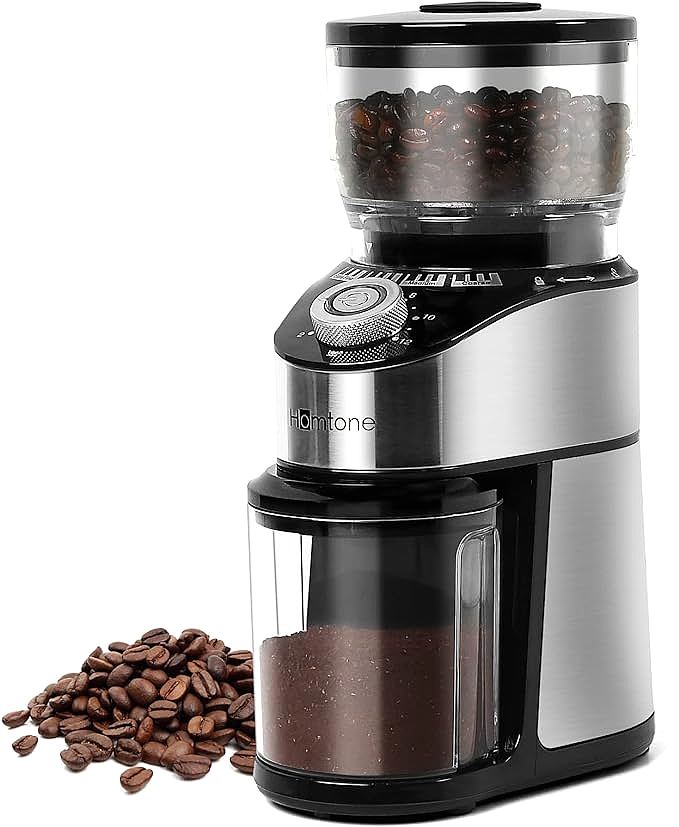
Homtone NK-0644 Electric Coffee Grinder: Unlock the Perfect Grind with Conical Burr Technology

Sincreative CG203A Conical Burr Coffee Grinder: Achieve Perfect Grind for Every Brew

Baratza Encore Conical Burr Coffee Grinder: Unlock the Flavor Secrets of Your Beans
