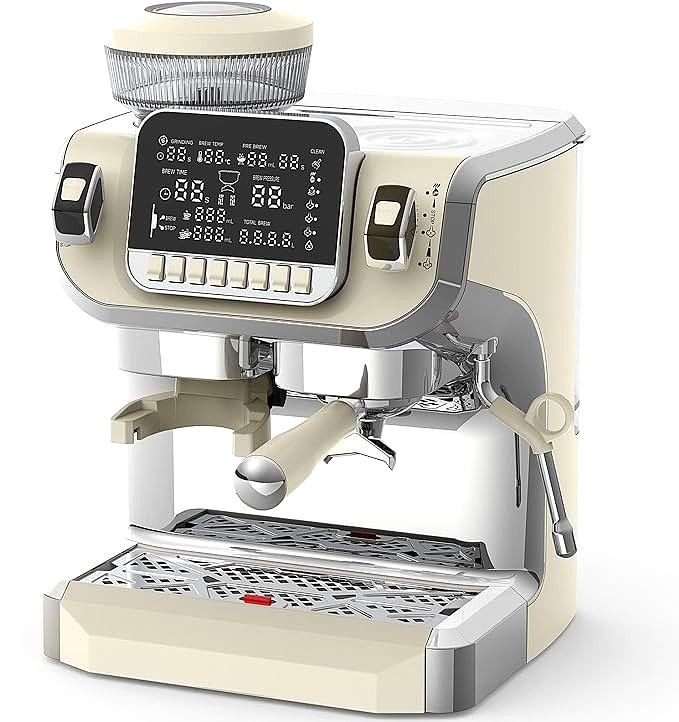
The Gaggia Brera: A Beginner's Guide to the Science of a Perfect Espresso Shot

Gaggia Brera Super-Automatic Espresso Machine
Espresso looks simple from the counter. A button, a cup, and a dark stream of liquid. What happens inside the machine between that press and the last drop is a chain of physical events: grinding, pressurizing, extracting, and measuring. The Gaggia Brera espresso machine automates most of that chain, which makes it a useful object to study if you want to understand how a good shot comes together. This guide follows the science first, then maps each principle onto the specific parts of the device so you can see where the hardware does the work for you and where your own choices still matter.
What Makes an Espresso Shot Espresso
The defining feature of espresso is how the water reaches the coffee. A pump forces hot water through a compact puck of finely ground beans under roughly 9 bars of pressure. That pressure, applied to a fine grind, is what pulls out a concentrated, fast-extracting liquid with body and a layer of crema. Without the combination of pressure, fine grind, and hot water, you get a hot cup of ground coffee that is not espresso.
Four numbers anchor the whole process:
- Pressure around 9 bars at the puck, the force that dissolves solubles quickly.
- Extraction time between 25 and 30 seconds, from the first drop to the cut.
- A ratio of about 1:2 by weight, one part coffee becoming two parts liquid.
- A water band of 90-96 degrees Celsius, the temperature that keeps the puck from scalding.
Temperature sits underneath all three timing variables. Water that is too hot scalds the puck and pulls out bitter, astringent compounds. Water that is too cool under-extracts and leaves the cup sour and flat. Get these four values close and the shot tastes balanced. Push any one of them far and the cup tips toward bitter or toward sour.
The crema is not decoration. It is a physical record of what the extraction did. A dense, tawny crema means the grind, the dose, and the pressure all produced enough dissolved gas to stay suspended. A shot with no crema is usually under-extracted or brewed from a grind that is too coarse. Watching crema form is a fast feedback loop for a beginner, far quicker than cupping every attempt.
Where the Machine Fits Into That Science
The Gaggia Brera Super-Automatic Espresso Machine (model B003XV31IG, silver variant), Small, 40 fluid ounces, is a super-automatic that grinds, doses, and brews in one closed loop. The hopper on top holds up to 250 grams of whole beans and pulls only what it needs for each cup. Because the grind happens just before extraction, the fresh grounds have not lost their volatile aromatics the way a pre-ground dose sitting in a basket would. That single design choice removes a common source of stale, flat shots.
The machine runs on a 1,250 watt element and is rated for 110 to 120 volts. Its rapid steam system is aimed at one weak spot of many automatics: time to temperature. A fast heat-up means the water is at extraction temperature before you press the button, rather than a cold first shot that pulls a sour, under-developed cup.

The Dosing and Grind Variable

Every automatic espresso machine still has one dial you turn: the grind size. Moving it finer or coarser is the main way you bend the extraction time to match your beans. A freshly roasted batch needs a coarser grind than an old, staled one, because staled beans have released their dissolved gas and hold less pressure at the puck. That means the same dose that once landed inside the 25-to-30 second window can start running long.
When extraction drags past the 30 second mark the cup turns bitter, and the fix is a coarser step. When the shot pulls in well under the 25-second start of that window, it tastes thin and sour, and the fix is a finer one. The dosing note that ships with the machine is a warning against a common beginner error: too coarse a grind, too little coffee, or a weak tamp all produce inadequate pressure. On an automatic like this, the grinding and the dose are handled for you, so the grind size is the variable that stays in your hands. Change one thing at a time, run two shots, and let the crema and the timer tell you which direction to move.
Water, the Forgotten Ingredient
Espresso is mostly water, so what you pour into the tank matters more than you think. Hard tap water leaves mineral deposits inside the boiler and the steam lines over months, and those deposits change how the machine heats and insulates the water. The 40 fluid ounce tank is about 1.2 liters, sized for a household making several drinks a day. It is not large enough to hide a bad water source.
Filtered or softened water keeps the internal components clean and the flavor neutral. You do not need a laboratory filter. A basic pitcher filter or a dedicated line filter is enough. The payoff is a machine that stays consistent shot to shot and a longer service life for the boiler and the group. Every few months, run a descaling cycle with a commercial descaler so the deposits never build up enough to warp the water temperature. The water tank, the drip tray, and the dregs drawer all sit on the front and open without reaching underneath, which makes the daily habit easier to keep.
Steaming Milk Is a Different Kind of Science

The Pannarello wand is a separate system from the brew pump. When you pull the wand out and open the valve, the machine uses the rapid steam to spin air and milk together. The physics is emulsification: you are trapping tiny air bubbles inside the milk proteins, and the protein foam that forms is what you call microfoam. Cold milk steams better than warm milk, because it has a wider window before it scalds. Aim for milk straight out of the fridge. The Pannarello wand also doubles as a hot water spout, which is how you make an Americano without a second machine or a filter.
Because the cup height adjusts from 3.25 to 4.5 inches, you can steam a small espresso glass or a tall latte cup without repositioning the whole unit. A latte is built by steaming the milk to a slightly warm, glossy texture, then pouring it over a shot so the milk and espresso fold into each other.
What to Check Before You Brew
- Bean hopper: 250 grams of whole beans.
- Water tank: 40 fl oz, which is about 1.2 L.
- Power: 1,250 W at 110-120 V.
- Voltage: 110-120 V.
- Cup height: 3.25-4.5 in.
- Warranty: 1 year, handled by Gaggia directly.
The listing is filed under a Made in Italy category, and the brand handles the one year warranty itself rather than pushing it through a third party. That is a small but real difference in how a repair request gets processed, because you deal with the maker of the part that failed.
Price and What Separates the Options
The Gaggia Brera black finish lists at $499.00 and the silver finish at $610.02, both in stock. The machines around it differ more in structure than in the espresso itself: the De'Longhi Classic Signature at $229.00 is a semi-automatic that leaves grinding and dosing to you, while the De'Longhi Magnifica Start at $599.95 is a super-automatic with a built-in conical burr grinder, a manual frother, and 13 grind settings. The Magnifica Duo at $999.95 adds a touchscreen display, 20 one-touch recipes, and a cold-brew brewing path.
For a beginner, the gap between a $229 machine and a $610 machine is not mostly in the espresso itself. It shows up in heat-up speed, grind consistency, steam power, and how clean the whole thing is to keep.
A Shot Routine That Respects the Science
- Fill the 40 fl oz tank with filtered water.
- Put whole beans in the 250 g hopper.
- Set the grind so a shot lands near 25 to 30 seconds.
- Preheat by pulling one short shot and discarding it.
- Brew into a warm cup and watch the crema build.
- Steam the cold milk to glossy, then pour over the shot.
The discarded preheat shot is a cheap way to stop making a sour first cup every morning, and it costs nothing but a little coffee. The rest of the routine is about keeping each variable stable so the machine can do the physics reliably, shot after shot.
Putting It Together
The Gaggia Brera espresso machine does not remove the need to understand espresso. It removes the need to do the physics by hand. Learn the four numbers, 9 bars, 25 to 30 seconds, a 1:2 ratio, and 90 to 96 degrees, and you can look at the device and see exactly what each button is doing. Adjust the grind to your beans, feed it clean water, steam cold milk, and it gives you a cup that is genuinely espresso rather than a hot cup of coffee pretending to be one.
Gaggia Brera Super-Automatic Espresso Machine
Related Essays

MEROL ME-720 Super Automatic
The Espresso Compromise: Unpacking the Science and Engineering in a Home Coffee Machine
The Science of the Shot: A Deep Dive into the 15-Bar Espresso Machine

The Soul of the Machine: Unlocking Espresso's Secrets with the Nuova Simonelli Musica

De'Longhi ESAM5500B Perfecta: Unlock Barista-Quality Espresso at Home

Espresso Extraction Pressure Flow: Dialing In by Grind and Gauge

Espresso Variables: Getting Consistent Results with the Gevi GECME403L-U

How a Home Espresso Machine Works and How to Use It
Neretva PE3680U 20 Bar Espresso