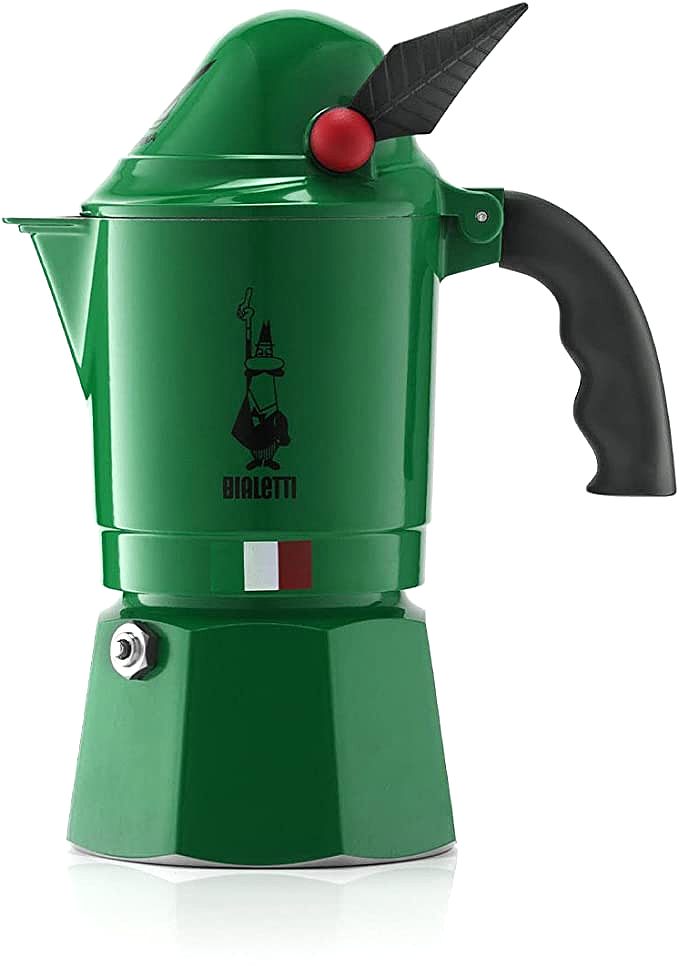
Why the Metal in Your Moka Pot Matters: A Guide to Stainless Steel Espresso

Bialetti Venus 4-Cup Induction Stovetop Moka Pot, 18/10 Stainless
Most moka pots you will find on a store shelf are made of aluminum. The Bialetti Moka Express, an octagonal pot that has defined this category since 1933, is cast aluminum, and the design still brews a respectable cup. It also leaves you stranded if your kitchen runs on induction. Anyone who cooks on a glass induction hob, or who simply wants a pot that can handle a decade of daily use without pitting, needs to look past the logo and think about the metal. This guide compares aluminum and stainless steel moka pots, explains what an 18/10 alloy does for your brew, and helps you pick the right pot for your stove.
What happens inside the pot
A moka pot works as a three-chamber boiler. Water goes in the lower chamber, ground coffee goes into the filter basket, and the top screws on tight. Heat converts the trapped water into steam. Pressure climbs to roughly 1.5 to 2 bar, and that pressure forces hot water up through the coffee bed and into the upper chamber. Espresso machines pull shots at 9 bar, so a moka pot lands between drip and espresso in strength. What pours out is hot, syrupy, and thick enough to carry a thin cap of foam when it rushes from the spout.
Water boils at 100 degrees Celsius, or 212 degrees Fahrenheit, at sea level. That temperature sits above the sweet spot for drip extraction, which is why moka coffee tastes more intense than a pour-over from the same beans. Grind medium-fine, a touch coarser than espresso, and the extraction stays clean. Tamp lightly and evenly so the water channels through the entire puck rather than blasting one weak spot. A channeled puck gives you a sour, hollow cup, and the fix is almost always a flatter, more even distribution of grounds.
Whatever metal the pot is made from sits between your flame and that process. It controls how quickly the water heats, whether the heat spreads uniformly across the base, and how the pot reacts when you slide it on and off the burner. A thin base cannot carry heat from the middle of the burner out to the edges, so the water at the center of the pot runs hotter than the water near the walls. One side of the coffee bed gets scalded and scorched before the other side has finished extracting, and the cup ends up burnt in one note and hollow in another. A thick base that spreads heat evenly across its full width is what keeps the whole puck extracting at the same time.
Aluminum: quick to heat, quick to wear
Aluminum moves heat at about 205 watts per meter-kelvin. It responds almost instantly when you turn the burner up or down. That responsiveness explains why the Moka Express has endured for ninety years: you hear the first gurgle and kill the heat before the brew scorches.
The weaknesses are not minor. Aluminum dents easily, pits with age, and reacts with acidic coffee oils over time. That is why the maker tells you to rinse the Moka Express by hand and avoid detergent entirely. Bare aluminum also absorbs minerals from hard water. An anodized layer slows the damage, but it chips, and once the coating fails the exposed metal pits faster. And plain aluminum is not ferromagnetic, which means it will not register on an induction cooktop. Place it on the glass and nothing happens.
Stainless steel: slower, far tougher, induction-ready
An 18/10 stainless steel moves heat at roughly 15 to 16 watts per meter-kelvin, about one-thirteenth of aluminum. A stainless pot needs more time to heat and keeps that heat longer after you remove it from the burner. That can work against you if you forget the pot on the stove. In return you get fewer hot spots and a more uniform extraction once the brew is underway.
The 18/10 marking means the alloy contains 18% chromium and 10% nickel. Chromium builds a passive oxide layer that fights rust and corrosion. Nickel stabilizes the crystal structure and adds toughness. Together they produce a pot that shrugs off hard water, ignores coffee oils, and handles the bumps and knocks of a busy kitchen far better than aluminum ever will. The surface also stays smoother over the years, which makes rinsing more effective and keeps old coffee oils from building up in micro-scratches.
Stainless steel is also the only common moka pot material that works on induction. Induction hobs transfer heat through magnetism, and the steel used in induction-ready pots contains enough iron to react to that field. The Venus range ships with a base that registers on induction, gas, electric, and ceramic hobs, which means one pot covers virtually every kitchen.
The Venus: a stainless pot with classic roots
Bialetti Venus 4-Cup Induction Stovetop Moka Pot, 18/10 Stainless, is the pot this guide centers on. The Venus is Bialetti's stainless steel take on the Moka Express, and it is built in Italy. The maker constructs it from 18/10 stainless and rates it for all hob types, induction included. The 4-cup model (B08556XV39) lists at $37.80 and brews about 5.7 ounces, which comes to roughly $9.45 per espresso cup of capacity. It weighs 520 g and measures 10.5 cm across the base, 7.5 cm deep, and 17.5 cm tall.

The 6-cup model (B07ZKZXM4B) lists at $45.47 for 7.9 ounces, about $7.58 per cup. Both sizes pour coffee suited to small espresso cups or bigger mugs.
The Venus keeps the familiar moka profile but softens the edges and adds a flip-top lid with a heat-resistant knob. The maker is blunt about cleaning: rinse every part with plain water, leave the detergent in the cabinet, and keep the pot out of the dishwasher. Detergent strips the seasoning and damages the seal, and dishwasher cycles pit the interior over time. Sizes follow espresso cups, so a 4-cup pot yields four real shots, not four oversized mugs.
Using the Venus is straightforward. Fill the lower chamber with water up to the valve, level the basket with ground coffee without tamping hard, screw the top on, and set it on a medium flame. When the pot starts to gurgle and coffee streams into the upper chamber, pull it off the heat. Letting it run dry scorches the brew and can damage the gasket.
The budget route: IMUSA 6-cup
If the Venus stretches your budget, the IMUSA USA Stainless Steel Stovetop Espresso Coffeemaker (B001AS529U) lists at $17.99 for 6 cups, about $3.00 per cup of capacity. That costs less than half as much per cup as the 6-cup Venus.

The maker claims the stainless body keeps coffee warm longer and distributes heat evenly for improved extraction. It works on gas, ceramic, and electric stovetops. The design adds a cool-touch handle and knob, plus a flip-up top with a side pour spout. It suits someone buying a first stainless pot, or anyone who wants steel at a lower price. IMUSA also lists the metal composition for the chemically cautious: the body contains iron, chromium, nickel, manganese, carbon, and phosphorus.
The aluminum alternative: Primula 6-cup
Stainless is not the only path. The Primula Classic Stovetop Espresso and Coffee Maker (B001J1L59E) is cast aluminum and lists at $19.99 for 6 cups, about $3.33 per cup.

It makes the same style of coffee, works on gas, ceramic, electric, and even propane camp stoves, and costs a couple of dollars more than the IMUSA. The catch is the metal itself. Cast aluminum heats fast and light, which is handy on a camp stove when you want a cup in minutes. It will not work on induction, it pits with age, and it demands the same rinse-only care as the Moka Express. A household with an all-gas kitchen and one daily brew is a fine home for a light aluminum pot.
Matching the metal to your kitchen
Begin with the cooktop. Induction narrows you to two realistic options: an induction-rated stainless pot or no pot at all. On gas or ceramic, both metals function, and the choice comes down to budget and how much maintenance you accept.
Think about your brewing rhythm next. A daily brewer who expects a decade of service gets more from 18/10 steel than from a $20 aluminum pot that dents and pits. A weekend brewer on a camp stove gets more from light aluminum, where weight and heat speed matter most.
Cleaning habits decide the rest. Stainless tolerates neglect better than aluminum, but the pot still wants a rinse and a dry. If dishwasher loading is non-negotiable, find a stainless model that explicitly permits it, and budget for more frequent gasket changes.
Keeping a stainless steel moka pot alive
Rinse every component with warm water after each brew. Dry the gasket and the threads before putting the pot back together, because trapped moisture breeds mold and breaks down the seal. Swap the gasket roughly once a year if you brew daily. A flattened gasket lets pressure bleed off and produces weak, watery coffee.
Descale the lower chamber every few months with a vinegar solution or a citric acid rinse, then flush thoroughly with plain water. Stainless handles this without complaint. Keep steel wool away from the interior; scratches in the passive layer invite rust spots. A soft sponge and warm water handle most residue.
Store the pot in pieces. Screwing the chambers together while they are still damp invites corrosion at the threads. The aluminum Moka Express can live assembled, though it shows water spots sooner. A spare gasket runs a few dollars and is the cheapest cure for a pot that sputters or leaks steam at the seam.
The short answer on metal
The metal in your moka pot determines what cooktop it works on, how it ages, and how much care it asks for. Stainless costs more on the shelf, and in return it shrugs off hard water, resists corrosion, and is the only common moka pot metal that works on an induction hob. Aluminum is cheaper and lighter, and it reaches brewing temperature fast. The tradeoff is a pot that dents, pits, and shows water stains sooner than steel, and one that is not induction-ready. Choose the metal that fits your kitchen, and the coffee will follow.
Bialetti Venus 4-Cup Induction Stovetop Moka Pot, 18/10 Stainless
Related Essays

Ilsa 3 Cup Stainless Moka Pot

Induction stovetop espresso maker: the Bialetti Venus 6-cup on a magnetic hob

SIXAQUAE Moka Induction Stovetop Espresso Maker: Brewing Perfect Espresso with Science
The Physics of Flavor: Deconstructing the Moka Pot's Steam-Powered Magic

Vapor, Metal, and Solvents: Engineering the Perfect Stovetop Brew


Alessi Moka Pot Guide: Design Meets Pressure Brewing
bonVIVO Intenca Stovetop Espresso Maker: A Practical Guide to Heat, Pressure, and Flavor
The Physics of Flavor: Deconstructing the Moka Pot